Nina Davies
Mzuzu University Inauguration Day 1999
The people of northern Malawi
were surprised that we existed.
"Ah Madam! We thought you were propaganda"
they confided
as we squeezed between them on Matolas.
In a calculated effort to draw in the North
Bakili Maluzi rumbled into Mzuzu
on a roll of UDF gold with
a shock of AK-47s
to inaugurate our university.
We of the teaching staff were
inappropriately robed
for the heat of a political rally
(for my mzungu skin
there was no blending in).
Cockroaches of the Academy
we scuttle
in a scorched tunnel
dry bone and bean
in a rattle
echoing party chants.
Men kaleidoscope
jump
miraculous
springs in dust
glittering
drum
every cell of themselves.
Ululating women
tongues
glistening like snails
beat our ground
to the grandstand
raising vanilla
of sweet potato and maize.
Praise of voices proclaim
Bakili!
His face paternal
yellow on chests
Bakili!
Undulating on
chitenji hips
Bakili!
g-force judders me in a
malarial invasion.
The mzungu’s quinine queasy
Bakili!
On the back of a flat bed lorry
climbing out of a vast pothole near Kafukule
a man dressed in twelve hours of road dirt and
a three piece suit asked
"Ah Madam! It is a real place with real books and teachers?"
"I'm not sure.
I am really not sure."
--------------------
Matolas - Bush taxi
mzungu - White person
chitenji - Cloth (worn like a sarong)
Nina Davies is an anthropologist with a research interest in the relationship between gender identity and material culture. She lives in Wakefield and is a member of the city's Black Horse Poets. Her blog is Precious Objects.

Follies: Monk & Goya
Melissa Flores-Bórquez

We are gathered here todayThese are lines from Geraldine Monk's 1980 Writers Forum pamphlet, La Quinta del Sordo, which is (roughly) The House of the Deaf Man, famously the name of Goya's two-story rectangular (according to art-historical research) cottage outside Madrid. Goya bought this in 1819, painting the "black murals" in oil on the walls. During the first five of the nine years he spent in the house, his last nine years, Goya also created Disparates ("Follies"), a series of etchings, the final grotesques from the sleep of reason.
because peacocks are pretty birds
and perfect monsters of iridescence
Did they begin withThe wax and acid of etching: the words in their formations, centred, prose with blank gaps, residual lines, the metal plain of the manual image of which paper can receive the print, printing as that moment in which paper is "awoken from its nightmare of whiteness" (Bachelard, The Right to Dream). Monk's hand often steadies itself against existing material - Goya, Hopkins, the dirge Lyke Wake, Donne - and runs resist and acid to deepen cuts, force new marks. Of La Quinta del Sordo Nate Dorward writes: "Flesh has become liquid or wax, so that distinctions between one, two or many figures are effaced."
a sharp and a parched rasp
a hissling furnace
a gang of heckling menace
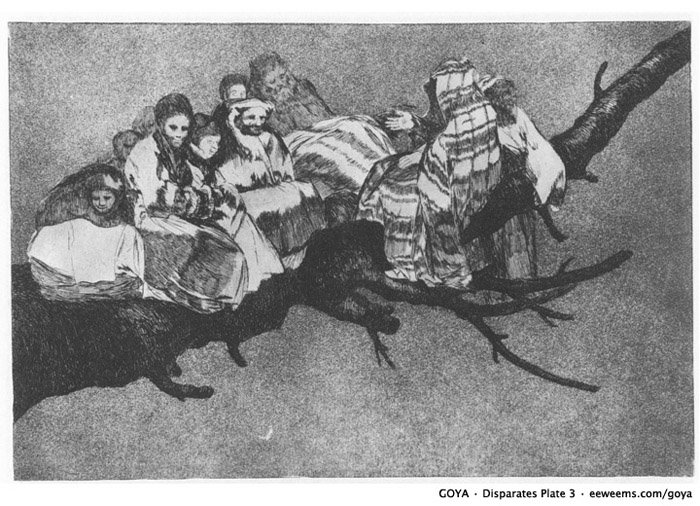
The etching which depicts a group of people clustered on a black bough provokes Monk's "We are gathered here today...", perhaps the sermon given by the shawled figure addressing the others, the words which wash through the gloom,
we are too smug and swingingHow can a twinned voice, which is double, attached to itself, speak out? Goya's siamese figure, "You will go where I go where I and you go. . ." Goya imagines this conjoining (from the picture, it looks like Ischio-omphalopagus, a Y shaped spine) as a burden, with the dominant twin taunting a crowd. Monk writes,
happy from this bough and bony thing
Let us reckon hard
with this block vengeance
Monk's wash of voices over these etchings reveals a technique of spoken dream, an oneiric space in which the image of the social has become unbounded, bodies without border: to write, to etch, to create surfaces by outlining them; to make marks upon the strongest material. To superpose perspective on perspective. Come, before the terrible sack race is lost.

Thomas Kinsella, Marginal Economy
review by Michael Peverett
Reviewer beware! Here is Kinsella noticing an old adversary at a funeral and listing their past clashes:
Recently, and sharpening
our exchange across the grave,
his finding the occasion
in the press of public affairs
– debating his fixed viewpoints
in a three-piece colonial accent –
for a murderous review :
a flow of acid colloquialisms
dismissing a main thesis
based on a misreading
of the images off the cover. . .
The review may have been murderous, but it can't have been more deadly than this. Copying it out, I count the strikes on my fingers, savouring that bit about the mock "debate", performed solo by the possessor of those fixed viewpoints. This is from "The Affair", one of the best of the dozen or so poems in this pamphlet; from the middle part of that poem, when it's in full flow. But very soon afterwards the poem breaks out of its rage and subsides:
– his thick back moving off
familiar among the others.
Under a shadow, forming
and descending, unfamiliar.
"Familiar" is an important word for Kinsella, but here it's the word "descending" that catches the ear. Here's the ending of another poem:
The soul confined,
her face pressed against the lattice.
Looking out at the day and the bright details
descending everywhere, selecting themselves
and settling in their own light.
It begins to be clear that there's a common pattern in these poems, a pointed abbreviation that puts a distance between the poem and the kind of writing (confiding, oracular, lyrical, or whatever) that it seemed to consist of.
So "First Night" leads us round and about, building up to an encounter with a famous bar-room narrator, like the frame of a short story. But when, finally, the encounter is made and the narrator starts talking, the poem ends without us hearing a single word. This is abrupt, and of course a good way of making you read the poem over to try and guess what's missing. But then the fact of it being missing is important too. There's no local colour in the pamphlet, not a single Irish name or turn of phrase, Dublin is only "the city". Kinsella in his seventy-eighth year writes with the energy of a younger man, the interests however go beyond a local setting; their sternness and pessimism suggest what is only reasonable, a sensibility formed in the 1950s. "Blood of the Innocent", "Marcus Aurelius", "Songs of Understanding" are all variations on the image of liberal humanism surrounded by a barbarous darkness which nevertheless is confessed to be in some sense more true to the realities of existence and thus a limiting critique; it registers a pressure-point that to younger writers no longer seems critical. Not that the problem has been resolved, such problems are never resolved, but it's drifted out of our focal range.
Still, you couldn't mistake this for the poetry Kinsella wrote in his formative years. Long gone are the terza rima and the blank verse, their refined spirit a potent residue in broken prose and intensely worked space.
This I think is meant for the reader:
Nightwomen,
picking the works of my days apart,
will you find what you need
in the waste still to come?
Waste takes centre-stage elsewhere, too. The ecological accent in this shit-stirring and in the slash-and-burn title poem has pulled the preoccupation with liberalism into some different shapes.
For the past thirty years Kinsella has committed himself, admirably and presciently, to the pamphlet form. The burning desire to publish a "full-length" collection – ultimately this is a publisher's conception, not a poet's – used to be fuelled by the belief that books broke into market-places where pamphlets didn't, but that doesn't make any sense now. Unless you live in a very privileged spot indeed, it's not possible to buy interesting books of new poetry from a shop. The pamphlet is therefore no less available than the book and is as often as not the more credible artefact; what I mean is, we more easily believe that it has a purposeful shape, a topicality, an intention. And besides, it marries better with the wave of online publishing that is giving us everyday access to large samples of what current poets are doing, which will certainly lead to a generation of better-informed purchasers who aren't at all moved by the publisher's implication that "this is a real book, therefore the author must be worth reading".
In Marginal Economy the economy is also assured technique: things are said once. Thus the brief final poem, "Rhetoric of Natural Beauty", describes a marine sunset, and nothing grows from the minutely troubling resonance of that title, until in its last words the affirmation that's forming becomes (so swiftly you can miss it) an ironic glitter and another baulking descent.
Marginal Economy (Peppercanister 24, February 2006, ISBN 1 904556 46 9) is distributed in Ireland by the Dedalus Press and in the UK by Carcanet.
Reviewer beware! Here is Kinsella noticing an old adversary at a funeral and listing their past clashes:
Recently, and sharpening
our exchange across the grave,
his finding the occasion
in the press of public affairs
– debating his fixed viewpoints
in a three-piece colonial accent –
for a murderous review :
a flow of acid colloquialisms
dismissing a main thesis
based on a misreading
of the images off the cover. . .
The review may have been murderous, but it can't have been more deadly than this. Copying it out, I count the strikes on my fingers, savouring that bit about the mock "debate", performed solo by the possessor of those fixed viewpoints. This is from "The Affair", one of the best of the dozen or so poems in this pamphlet; from the middle part of that poem, when it's in full flow. But very soon afterwards the poem breaks out of its rage and subsides:
– his thick back moving off
familiar among the others.
Under a shadow, forming
and descending, unfamiliar.
"Familiar" is an important word for Kinsella, but here it's the word "descending" that catches the ear. Here's the ending of another poem:
The soul confined,
her face pressed against the lattice.
Looking out at the day and the bright details
descending everywhere, selecting themselves
and settling in their own light.
It begins to be clear that there's a common pattern in these poems, a pointed abbreviation that puts a distance between the poem and the kind of writing (confiding, oracular, lyrical, or whatever) that it seemed to consist of.
So "First Night" leads us round and about, building up to an encounter with a famous bar-room narrator, like the frame of a short story. But when, finally, the encounter is made and the narrator starts talking, the poem ends without us hearing a single word. This is abrupt, and of course a good way of making you read the poem over to try and guess what's missing. But then the fact of it being missing is important too. There's no local colour in the pamphlet, not a single Irish name or turn of phrase, Dublin is only "the city". Kinsella in his seventy-eighth year writes with the energy of a younger man, the interests however go beyond a local setting; their sternness and pessimism suggest what is only reasonable, a sensibility formed in the 1950s. "Blood of the Innocent", "Marcus Aurelius", "Songs of Understanding" are all variations on the image of liberal humanism surrounded by a barbarous darkness which nevertheless is confessed to be in some sense more true to the realities of existence and thus a limiting critique; it registers a pressure-point that to younger writers no longer seems critical. Not that the problem has been resolved, such problems are never resolved, but it's drifted out of our focal range.
Still, you couldn't mistake this for the poetry Kinsella wrote in his formative years. Long gone are the terza rima and the blank verse, their refined spirit a potent residue in broken prose and intensely worked space.
This I think is meant for the reader:
Nightwomen,
picking the works of my days apart,
will you find what you need
in the waste still to come?
Waste takes centre-stage elsewhere, too. The ecological accent in this shit-stirring and in the slash-and-burn title poem has pulled the preoccupation with liberalism into some different shapes.
For the past thirty years Kinsella has committed himself, admirably and presciently, to the pamphlet form. The burning desire to publish a "full-length" collection – ultimately this is a publisher's conception, not a poet's – used to be fuelled by the belief that books broke into market-places where pamphlets didn't, but that doesn't make any sense now. Unless you live in a very privileged spot indeed, it's not possible to buy interesting books of new poetry from a shop. The pamphlet is therefore no less available than the book and is as often as not the more credible artefact; what I mean is, we more easily believe that it has a purposeful shape, a topicality, an intention. And besides, it marries better with the wave of online publishing that is giving us everyday access to large samples of what current poets are doing, which will certainly lead to a generation of better-informed purchasers who aren't at all moved by the publisher's implication that "this is a real book, therefore the author must be worth reading".
In Marginal Economy the economy is also assured technique: things are said once. Thus the brief final poem, "Rhetoric of Natural Beauty", describes a marine sunset, and nothing grows from the minutely troubling resonance of that title, until in its last words the affirmation that's forming becomes (so swiftly you can miss it) an ironic glitter and another baulking descent.
Marginal Economy (Peppercanister 24, February 2006, ISBN 1 904556 46 9) is distributed in Ireland by the Dedalus Press and in the UK by Carcanet.
Kenneth Koch's The Beverly Boys' Summer Vacation
First part of a review of Kenneth Koch's The Collected Fiction
Laura Steele
The Collected Fiction contains a novel, three collections of short stories and two miscellaneous works. Because summer is the time to ponder Kenneth Koch, I'm going to consider each work separately. The first fiction is a curiosity, by far the shortest piece here:
1. The Beverly Boys' Summer Vacation (1958)
Twenty-one chapters in six pages: this reads like the wide-eyed text to a beautifully illustrated picture book, each chapter a short paragraph, a summer vacation in postcards.
Of course they will. And there is no slip in the tone of telling; no mixing of registers: Bill and Bob Beverly will see a lizard, meet an orphan called Tugboat Ted, and even climb up Top-Notch Peak. If produced as a picture book, I can imagine a sticker saying "Ages 2-4", and a sigh of relief as parents discover that at least this specimen of the genre is crisply written and fast-paced. The Beverly Boys' Summer Vacation is the form of breathless summer adventure set into chaos by Ashbery in Girls On The Run. In this collected volume, it stands as an invitation to read further: the boys' adventure story will be elaborated on at length in The Red Robins (1975), a novel about a group of young aviators who fly around Asia. But there are no such extensions here; instead, a crystallised sunniness is seen to bleach a little as it fixes into place:
[ISBN 10:1-56689-176-0 $18.00 6 x 9 408 pages Paperback Coffee House Press]
Laura Steele
The Collected Fiction contains a novel, three collections of short stories and two miscellaneous works. Because summer is the time to ponder Kenneth Koch, I'm going to consider each work separately. The first fiction is a curiosity, by far the shortest piece here:
1. The Beverly Boys' Summer Vacation (1958)
Twenty-one chapters in six pages: this reads like the wide-eyed text to a beautifully illustrated picture book, each chapter a short paragraph, a summer vacation in postcards.
Chapter 2. A LAST WINKThe tale begins with the slight emotional and physical displacement which has launched a thousand children's books. Instead of the summer at Town Hut, by the lake, the Beverly Boys are to spend the summer at Roundup Hut, "in the interior of the woods". So the narrative question is, Will they have a good time?
The Beverly Boys knew it was their last night at Town Hut, where they had had so much fun in previous summers. In the morning Bobby didn't want to get up right away because it made him so sad to leave the summer home. Aunt Bertha let him stay in bed an extra five minutes, so as to have a last wink of sleep at Town Hut.
Of course they will. And there is no slip in the tone of telling; no mixing of registers: Bill and Bob Beverly will see a lizard, meet an orphan called Tugboat Ted, and even climb up Top-Notch Peak. If produced as a picture book, I can imagine a sticker saying "Ages 2-4", and a sigh of relief as parents discover that at least this specimen of the genre is crisply written and fast-paced. The Beverly Boys' Summer Vacation is the form of breathless summer adventure set into chaos by Ashbery in Girls On The Run. In this collected volume, it stands as an invitation to read further: the boys' adventure story will be elaborated on at length in The Red Robins (1975), a novel about a group of young aviators who fly around Asia. But there are no such extensions here; instead, a crystallised sunniness is seen to bleach a little as it fixes into place:
Chapter 19. GREEN ARE THE TREES
On the ride back everyone noticed how green the trees were. "It is September already," said Aunt Bertha smilingly, "and yet the leaves have not yet begun to turn. Maybe the trees are like us, and want to remember and enjoy as long as possible the fun they have had during the summer."
[ISBN 10:1-56689-176-0 $18.00 6 x 9 408 pages Paperback Coffee House Press]
Three Poems by Aase Berg
with English translation by Johannes Göransson
Deformationszon
Viltstängslet har upphört
fladdermusar fittar sig
kring krubbet
Vårt pösmunkfetto slaggar
i sin goda ro,
som stötdämpad
av svallningar
i knubbet
Deformation Zone
The wilderness fence has ceased
flutterbats cunt
around the grub
Our doughnut-fatso slops
in peace and quiet,
as if shock-muffled
by ripples
in the plump.
Filt
Gilla lunk
simma lugnt
stilla flyter gråten
Bråten flottas
genom tålamodets hjärna
Hundåren tar hundra år
Blanket
Like lope
swim calmly
slowly flow the cries
Junk shipped
through the patience brain
Dog years last a houndred years
Fotboj
Hålla sig i skinnet
spänna vingeskinnet
Drakläge vidgas
i stilleståndsdans
jordbalans
Foot Buoy
Hold on to one's skin
fasten the wing skin
Dragon phase unfolds
in a standstilldance
earthbalance
These poems are from Berg’s latest collection in Swedish, Uppland (Bonnier, 2005, ISBN: 9100103837). Remainland is a selection of Berg’s poems translated into English by J Göransson, (Action Books, 2005, ISBN 0-9765692-0-5).
Deformationszon
Viltstängslet har upphört
fladdermusar fittar sig
kring krubbet
Vårt pösmunkfetto slaggar
i sin goda ro,
som stötdämpad
av svallningar
i knubbet
Deformation Zone
The wilderness fence has ceased
flutterbats cunt
around the grub
Our doughnut-fatso slops
in peace and quiet,
as if shock-muffled
by ripples
in the plump.
Filt
Gilla lunk
simma lugnt
stilla flyter gråten
Bråten flottas
genom tålamodets hjärna
Hundåren tar hundra år
Blanket
Like lope
swim calmly
slowly flow the cries
Junk shipped
through the patience brain
Dog years last a houndred years
Fotboj
Hålla sig i skinnet
spänna vingeskinnet
Drakläge vidgas
i stilleståndsdans
jordbalans
Foot Buoy
Hold on to one's skin
fasten the wing skin
Dragon phase unfolds
in a standstilldance
earthbalance
These poems are from Berg’s latest collection in Swedish, Uppland (Bonnier, 2005, ISBN: 9100103837). Remainland is a selection of Berg’s poems translated into English by J Göransson, (Action Books, 2005, ISBN 0-9765692-0-5).
A Douglas Oliver Hyper-Link Crystal
Poems
[#] 'Bigotry' (at The East Village Poetry Web)
"Consider the bigot, how he spins."
[#] 'A Time of Colonels'
"The colonels dissolve into tortures."
[#] 'On Louise Michel'
[#] 'Louise Seen by Lightning'
"Writing by lightning to the fetish skeletons
a flash: bombazine gown.
Two words where the words don't be yet." with Alice Notley
[#] 'Again In Dorset' at CCCP
"Under old caves memory shadowed
rotten teeth of mildewed thatch
again in Dorset of William Barnes
revisiting metaphor and simile after many years
for the sake of those years
House martens' rinsed noise
as white rumps dart in and out of wall nests
on their own summer revisit
Corn laid by storm loses fullness
but earth recuperates the gain
Corn clothed
cloffed
corn clothed and dragged, laid against the standing stalks,
corn like an upwards rain"

[#] 'Wealh People', 'Forearms', and 'B.W.I.M. (By Which I Mean)'
at Lynx: Poetry from Bath
"Cirrus on blue above.
Matt black fighter plane
dropped in the road by a child
sets its heel on the sparkling tarmac,
the silhouette of it skids about and becomes
curling tyre marks"
Interview
[#] UNION IN NARRATIVE - John Olson interviews Alice Notley and Douglas Oliver
"I'm intensely concerned about how poetry should now be seeking a more public space"
Prose
[#] 'The School of Bedlam' (from Whisper 'Louise', Jacket)
[#] unedited pages from Whisper 'Louise' in Quid #1 (pdf)
[#] 'Of bigotry and idealism' (from Whisper 'Louise', Masthead)
[#] Introduction to a selection of Diagram Poems in A Various Art
i.m. Douglas Oliver 1937 - 2000

[#] Poem: 'The Heron' in Ecopoetics #1 (pdf)
[#] Farewell to Douglas Dunlop Oliver
Poem: 'Our Generation (for Steve Carey)'
A Lament for Douglas Oliver by Ian Ayres
A reprint of Nicholas Johnson's obituary from The Independent (not The Times as stated at the site):
"Robert Louis Stevenson, who wrote Dr Jekyll and Mr Hyde in Bournemouth in the 1880s, became one of Oliver's heroes, an instructor in 'how to wrestle with the presbyterian background in a way which restores honour to the parents.' Stevenson's house (Shelley's manor), King's Park, where Douglas and his brother Brian watched boxing matches, and Christchurch harbour, where he studied sea and shore birds, were childhood haunts."
[#] Andrew Crozier's obituary in The Guardian
[#] 'WATUSI - In Memoriam Barry MacSweeney and Doug Oliver' by Allen Fisher
"with spacetime talk, in rested weeds"
Archive
[#] Catalogue of the Douglas Oliver archive at the University of Essex
[#] Literary Encyclopedia entry (first 600 words free to view)
Essay on Oliver
[#] 'Ventriloquising Against Harm'
John Hall's essay review of Whisper 'Louise'
"This book can be seen both as an individual component of 'the whole life's work' and as an attempt to summarise and reflect on that whole. For Oliver there could be nothing serene about such an undertaking. The responsibility of engaging with a 'whole view of life ... means that there's this political, historical and personal journey to undertake before I can reach towards a poetics'."
Blog Posts on Oliver
[#] Jon of Posthegemony writes two posts on The Diagram Poems:

[#] Diagram I
"Oliver's poems--and the all-important diagrams--are neither celebration nor condemnation of the Tupamaros. They are, perhaps, an attempt precisely to diagram the forcefields within which they operated, and into which they intervened."
[#] Diagram II
"The diagram is the record of the plan, the virtual marshalling of guerilla forces, but also the record of its actualization, and the way in which actualization entails the elimination of incompossible worlds: the virtual is a garden of forking paths that can enfold divergent outcomes"
[#] Dominic Fox of Poetix:
"Oliver is a great poet, not especially difficult to read but decidedly difficult to pin down, and this is due to something rather paradoxically particular and defining about his poetry: its adherence to poverty. [...] Poverty as a lack or weakness at the heart of some system, be it social or intellectual. This lack appears as a sign of the system's limitations, its inability to systematize absolutely everything."
Reviews
[#] Peter Manson reviews Penniless Politics
"Richness Oliver can do. The poem treats of the 'Voodoo-Haitian' Emen, her Anglo-Scot poet husband Will Penniless, and the birth of Spirit, a new political party for the non-voting U.S. majority ('Make material wealth for other people, spiritual wealth for ourselves')."
[#] Tim Allen reviews Etruscan Reader #8 Tina Darragh / Douglas Oliver / Randolph Healy
"A central piece here is 'Future Circles' in which the Oliver talks to 19th C. French revolutionary, Théophile Ferré, and his girlfriend Louise Michel, at the back of a New York bus."
[#] Tony Frazer reviews Arrondissements at Shearsman

[#] Review of Arrondissements at Terrible Work
"he's invented a spray-paint particle-ray gun which Turnerises its victims into whirls of fog and rainbow smears"
[#] Martyn Everett reviews Whisper 'Louise'
[#] Tim Allen essays Whisper 'Louise'
Bibliography
Whisper 'Louise' (Reality Street, 2005)
Arrondissements (Salt, 2003)
Wendy Mulford & Peter Riley (eds): A Meeting for Douglas Oliver (Poetical Histories, Infernal Methods & Street Editions.) A memorial festschrift which also contains 27 uncollected poems.
A Salvo for Africa (Bloodaxe, 2000)
Etruscan Reader #8 (with Tina Darragh and Randolph Healy) (etruscan, 1998)
Penguin Modern Poets 10 (with Iain Sinclair and Denise Riley) (Penguin, 1996)
Selected Poems (1996, Talisman House)
What Fades Will Be (1993, Poetical Histories)
Penniless Politics (Bloodaxe, 1994, Hoarse Commerce, 1992)
The Scarlet Cabinet (with Alice Notley) (Scarlet Editions, New York 1992)
Three Variations on the Theme of Harm (Paladin, 1990)
Poetry and Narrative in Performance (Palgrave Macmillan, 1989)
Kind: Collected Poems (Allardyce, Barnett, 1987)
The Infant and the Pearl (Ferry Press, 1985)
The Diagram Poems (Ferry Press, 1979)
In the Cave of Suicession (Street Editions, 1974)
The Harmless Building (Grosseteste, 1973)
Oppo Hectic (Ferry Press, 1969)
-----
Links maintained by Edmund Hardy. If you find a broken link or an Oliver page overlooked, please get in touch.
Kierkegaard's Styles: The Sickness Unto Death

Edmund Hardy
1.
Doubt is a doubling. A human being is a relation between two, "the infinite and the finite, of the temporal and the eternal, of freedom and necessity, in short, a synthesis." (XI 127)
The activity of relating the self to the self, "self" becoming verb.
When the synthesis fails, a misrelation between the sides can be called despair: in such a state, the self tries to will itself away, or it tries to will itself to be itself.
The self cannot rest.
The formula that describes the state of the self when despair is completely rooted out is this:
"in relating itself to itself and in willing to be itself, the self rests transparently in the power that established it" (XI 128).
The rested transparency is rested from an attachment to infinititude, and from an attachment to the finite, because the self does not attach, it relates to others as it relates itself to itself.
2.
Despair figured as dialectical, the form of The Sickness Unto Death is also so: compacted paragraphs, clear blocks with which to show an "upbuilding" for the reader. So as the argument blazes itself in clarity, and burns itself towards the unifying negative third, becoming spirit that is becoming self, so we are to be "awoken" as Lazarus was to the cry, "Lazarus, come out" (John 11:43), and the voice must speak from a great height, if it is to dare say this to us.
This is a Christian style, that of speaking to us from a position and in a relation which can only place us on a sickbed, or a death-bed; the urgency which compacts the prose of The Sickness Unto Death is intended to convey our situation of danger.
3.
The preface contains a remark usually thought to be a side-swipe at Hegel: "it is not Christian heroism to be taken in by the idea of man in the abstract or to play the wonder game with world history." The wonder-game (or "wonder stool") is when one person is blindfolded and sits on a stool. Then others all write down what they wonder about that person who, unblindfolded, must then match up person to what they wondered.
The self is always in trouble when it is given a chair; far from being rested, it is now enthroned. For Sartre, opposing Kierkegaard to Hegel in 'The Existence of Others' chapter of Being and Nothingness, is keen to point out that consciousness is "selfness and not the seat of an opaque, useless Ego." For Sartre, consciousness is the Ego's "decompression", another form of rested transparency (in a transcendental field).
4.
Kierkegaard's style is to write this formal text, and sign it, Anti-Climacus. This is one of Kierkegaard's pseudonyms who writes from a "high" position. As Kierkegaard noted in his journal, "one seems to be able to detect in Anti-Climacus that he considers himself to be a Christian on an extraordinarily high level", whereas the earlier author, to whom Anti-Climacus has a special relation, Johannes Climacus, had been a low pseudonym (1), so low that he had ended Concluding Unscientific Postscript by declaring the book to be superfluous, a position of retraction entirely alien to Anti-Climacus. Kierkegaard considered himself to be somewhere between the two levels.
5.
What follows is an anthropology of despair. The self shut behind a door. The self willing not to be itself before God. The despair of immediacy caught in a dialectic of pleasant, unpleasant. The self shut in front of a door: The man of immediacy has reduced a mirror to a miniscule, "In a deeper sense, the whole question of the self becomes a kind of false door with nothing behind it in the background of his soul." (XI 168)
The forms of despair are "qualifications of the spirit". Despairing is to place the kinetic self into a field of power which is not the highest power. "O Socrates, Socrates, Socrates! Yes, we may well call your name three times; it would not be too much to call it ten times, if it would be of any help." (Xi 203) The style lifts up with the appearance of Socrates who arrives with the idea of sin as ignorance. "Philosophy still thinks this, and it should know better!"
Macbeth is the man who despairs at his own sin, despair closing in as a series of fixed points. Kierkegaard quotes the Schlegel Tieck translation of Shakespeare, where, having killed the king, Macbeth says, "Von jetzt giebt es nicht Ernstes mehr im Leben; Alles ist Tand, gestorben Ruhm und Gnade." (Translated back into English: "For, from this instant, there's nothing serious in mortality; All is but toys, renown and grace is dead."
Kierkegaard admires the "double turn" in the last words, Ruhm und Gnade, renown and grace, and comments: "by despairing over his sin, he has lost all relation to grace – and also to himself." Macbeth loses all rest in any higher power (or force-field of many selves, Sartre's concept extended), he's caught on this bank or "shoal". In the references to Shakespeare, it becomes clear how certain areas of the upbuilding could be laicised, as Hume laicised belief.
The spiral of the discourse comes round, and out from despair in the last sentence, where the formula for lack of despair is seen to be also the "definition of faith." Up through this spiral, it is as if the author has been judging himself, pushing through the forms of his own despair.
Let not the heart in sorrow sin so
you abandon love
-----------------------------
(1) The other low pseudonyms are Victor Eremita, Mr A., Judge William, Johannes de Silentio, Constantin Constantius, Vigilius Haufniensis, Nicolaus Notabene, Hilarius Bookbinder, Frater Taciturnus and Inter et Inter.
[Quotations from The Sickness Unto Death are from the edition edited and translated by Howard V. Hong and Edna H. Hong, Princeton, 1980]
"Dear angel of impeccable dispirit"
Keston Sutherland's The Rictus Flag reviewed by Edmund Hardy
A concentration of strong stresses conveys high pulse excitement. Direct statements of an affective life cut in then out, replaced by sentences where transitions, tendencies, passages - associations - between words have been spliced and mixed gleefully. The result is the transferable grin of The Rictus Flag.
[. . . ] Say nothing
happens and the days waste up you prettify
cough your knees out not
remove inner core through front slot
– same. But,
with the electrons unionized,
fate bent on tongue-ionamines, a fountain
of smoke rakes through, bit-necked
altruism under the stars weigh up chitin on
event speech blackout. [. . .]
(from 'A Hyena Asleep In A Willow')
Passengers on the London train out
the window gravel and paint
tired. Sex is disclosed you took
up the converted hamper flipping
its pointless lock open. I can't sit
and long desperately for you alone.
(from 'Extreme Sweet')
The first of these extracts deploys hypallage and over-determination of possibilities causing ambiguity; the second contains a middle sentence which switches in at least three ways. Ambiguity may be thought of in these poems as a demotic which expands out from every part of speech, through different tones, specialist vocabulary and forms of address.
'Extreme Sweet' is the opening poem and is also the most compact, four blocks on a page. A fever of ironic Romanticism cut across by sexual order-words –
*
The poetry in The Rictus Flag can also read as bundles of associations dropping down to fill up the stanza shapes. In an exchange with Chris Goode (reproduced in Quid 10 iii), Sutherland determines, "A condition promoting focus may at the same time make that focus more difficult to achieve; differently put, I often intend to concretize in poetic language the real ambivalence and perplexity of focusing". Focusing on what? Sutherland continues: "I struggle to fixate upon the infracted image of what I am as a generalization attesting the administered suppression of human particularity, and to force that image squarely to the front (rather than the centre) of my poetry, claiming responsibility for it as noisily as possible, again in order that the objective and painful limits of my responsibility in a society overdetermined by Capitalist exchange can ring out clearer and more violently."
This could be describing a process figured as a not-mechanical camera designed to produce a negative of the impossible: a lens of perplexed focus struggles to produce an (infracted) image which, scored and fuzzy from the focusing difficulty, is itself an aperture through which "interpellation's fire" (1) can be seen, and therefore felt. "I believe that the peculiarity of art is to 'make us see' (nous donner à voir), 'make us perceive', 'make us feel' something which alludes to reality" (Althusser, 'A Letter on Art in Reply to André Daspre').
Althusser goes on to speak of how Macherey has extended Lenin's critique of Tolstoy: Balzac and Solzhenitsyn "make us 'perceive' (but not know) in some sense from the inside, by an internal distance, the very ideology in which they are held." For this seeing - or something approaching it - to be present in a contemporary lyric, Sutherland must fixate on what I am (2) but only in a defiance which spirals around in the energy of its not quite being possible.
*
Threads which reappear through these six poems include: different forms of thread ("chitin", used in surgery, strong but over time dissolving; fabrics; polyglactin), democratic representation, the wind, life diminished or withheld, parts of the body as it were de-centred (turning to dust, engaging with other bodies, falling off). How is the focus disturbed; what is visible? A full text of one of the poems, 'Ode: What You Do', is available to read at Poetry Review, so I'll end with a few notes on that:
What does Eros permit? Reading Sutherland, it will not be long before a line such as this appears: "Sabra and Shatila thread through // love" - the ethhical implications of such a stance are perhaps what imbues the final line of part 1, when I read, with the sound of a cry: "The ring of fire shines and divorces." The painful limit? The safe perimeter of sleep? This could be followed to part 3, "get soapy // life mere twist into synecdoche" - where part standing for whole is a "shredding" - in "dreams", or is it illusion, instead of error the real danger for thought. But I have skipped part 2, which brings a focus on unhappiness, depression: is it a wound, does it need stitching ("vicryl")? Autologous: In blood transfusion and transplantation, a situation in which the donor and recipient are the same person. The sentence which begins "I don't walk to the / bus stop" and ends "he hides and then buries his face" enacts in miniature many of the difficulties of focus: how does power affect the body, shifting out - or vaguely drifting on - to connections with steel, tree, disgust, from first to third.
These readings could then be followed into the subsequent parts of the poem crossing (in 4 an orgasm "sneezes away news", in 3 "You dust / off the mimic, dust away my eyes" could be tears, connecting in 5 to "my bent eyes scattering salt over") over, contradictory crash.
[24pp A5 stapled, £3 including postage and packing in UK only, ISBN 1-903488-16-8, Object Permanence]
----------
(1) Denise Riley, The Words of Selves. The biblical overtones come from Judith Butler's discussion of Althusser's interpellation as theological.
(2) In the aspect of the particular generalization, I'm reminded of Badiou quoting Lin Piao with approval, "that the essential thing was to be, at a revolutionary conjunction, both its actor and its target". Alain Badiou, Ethics: An Essay on the Understanding of Evil. Trans. Peter Hallward
'Extreme Sweet' is the opening poem and is also the most compact, four blocks on a page. A fever of ironic Romanticism cut across by sexual order-words –
Instead of ropes the descent in– so that the Romantic wind picks up "heartless blood", throws cars around. Wordsworth: "Is it a reed that's shaken by the wind, / Or what is it that ye go forth to see?" (Calais, August, 1802).
autumn from the trees belongs
to leaves agitated by our rapacity,
by any exit. Throw your legs open.
Heartless blood in the wind, thin
spaced eyelashes and cars,
tossed there and all glassier than bat
breath on your mirror. [. . .]
*
The poetry in The Rictus Flag can also read as bundles of associations dropping down to fill up the stanza shapes. In an exchange with Chris Goode (reproduced in Quid 10 iii), Sutherland determines, "A condition promoting focus may at the same time make that focus more difficult to achieve; differently put, I often intend to concretize in poetic language the real ambivalence and perplexity of focusing". Focusing on what? Sutherland continues: "I struggle to fixate upon the infracted image of what I am as a generalization attesting the administered suppression of human particularity, and to force that image squarely to the front (rather than the centre) of my poetry, claiming responsibility for it as noisily as possible, again in order that the objective and painful limits of my responsibility in a society overdetermined by Capitalist exchange can ring out clearer and more violently."
This could be describing a process figured as a not-mechanical camera designed to produce a negative of the impossible: a lens of perplexed focus struggles to produce an (infracted) image which, scored and fuzzy from the focusing difficulty, is itself an aperture through which "interpellation's fire" (1) can be seen, and therefore felt. "I believe that the peculiarity of art is to 'make us see' (nous donner à voir), 'make us perceive', 'make us feel' something which alludes to reality" (Althusser, 'A Letter on Art in Reply to André Daspre').
Althusser goes on to speak of how Macherey has extended Lenin's critique of Tolstoy: Balzac and Solzhenitsyn "make us 'perceive' (but not know) in some sense from the inside, by an internal distance, the very ideology in which they are held." For this seeing - or something approaching it - to be present in a contemporary lyric, Sutherland must fixate on what I am (2) but only in a defiance which spirals around in the energy of its not quite being possible.
*
Threads which reappear through these six poems include: different forms of thread ("chitin", used in surgery, strong but over time dissolving; fabrics; polyglactin), democratic representation, the wind, life diminished or withheld, parts of the body as it were de-centred (turning to dust, engaging with other bodies, falling off). How is the focus disturbed; what is visible? A full text of one of the poems, 'Ode: What You Do', is available to read at Poetry Review, so I'll end with a few notes on that:
What does Eros permit? Reading Sutherland, it will not be long before a line such as this appears: "Sabra and Shatila thread through // love" - the ethhical implications of such a stance are perhaps what imbues the final line of part 1, when I read, with the sound of a cry: "The ring of fire shines and divorces." The painful limit? The safe perimeter of sleep? This could be followed to part 3, "get soapy // life mere twist into synecdoche" - where part standing for whole is a "shredding" - in "dreams", or is it illusion, instead of error the real danger for thought. But I have skipped part 2, which brings a focus on unhappiness, depression: is it a wound, does it need stitching ("vicryl")? Autologous: In blood transfusion and transplantation, a situation in which the donor and recipient are the same person. The sentence which begins "I don't walk to the / bus stop" and ends "he hides and then buries his face" enacts in miniature many of the difficulties of focus: how does power affect the body, shifting out - or vaguely drifting on - to connections with steel, tree, disgust, from first to third.
These readings could then be followed into the subsequent parts of the poem crossing (in 4 an orgasm "sneezes away news", in 3 "You dust / off the mimic, dust away my eyes" could be tears, connecting in 5 to "my bent eyes scattering salt over") over, contradictory crash.
[24pp A5 stapled, £3 including postage and packing in UK only, ISBN 1-903488-16-8, Object Permanence]
----------
(1) Denise Riley, The Words of Selves. The biblical overtones come from Judith Butler's discussion of Althusser's interpellation as theological.
(2) In the aspect of the particular generalization, I'm reminded of Badiou quoting Lin Piao with approval, "that the essential thing was to be, at a revolutionary conjunction, both its actor and its target". Alain Badiou, Ethics: An Essay on the Understanding of Evil. Trans. Peter Hallward
George Messo, Entrances
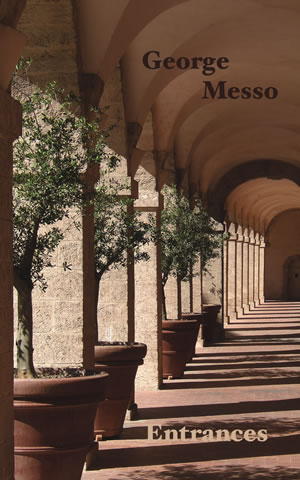
Reviewed by Jamie Wilkes
As reviewer, I find myself in a curious position here. I'm rather ignorant of the literary tradition in which George Messo has established himself, as a translator of several modern Turkish poets whose work I'm not familiar with (Özdemir Asaf, Melih Cevdet Anday, and İlhan Berk), and yet I have some experiential knowledge of the area of northern Turkey around which this collection gathers, having walked and hitched through a few small villages around Artvin in search of the long-abandoned Georgian churches to be found there. From my experience at least, the details taken from life in these poems ring absolutely true:
"LO(RD) JESUS CHRIST.".....I make out a "SO(U)L."
"IN THE MON(TH) OF ATHYR."....."LEUCIU(S) FELL A(SL)EEP."
Where they mention age....."HE LI(VE)D...YEARS."
The Kappa Zeta shows.....that he fell asleep young.
Among the many worn-away pieces.....I see "HI(M)...ALEXANDRIAN."
Then there are three lines.....that are quite mutilated;
but I make out a few words–.....as "OUR TE(A)RS," "SORROW,"
then again "TEARS,".....and "W(E) HIS (F)RIENDS MOURN."
It seems to me that Leucius.....must have been dearly beloved.
In the month of Athyr.....Leucius fell asleep.
As reviewer, I find myself in a curious position here. I'm rather ignorant of the literary tradition in which George Messo has established himself, as a translator of several modern Turkish poets whose work I'm not familiar with (Özdemir Asaf, Melih Cevdet Anday, and İlhan Berk), and yet I have some experiential knowledge of the area of northern Turkey around which this collection gathers, having walked and hitched through a few small villages around Artvin in search of the long-abandoned Georgian churches to be found there. From my experience at least, the details taken from life in these poems ring absolutely true:
He spoke a peculiar dialect.
The ruined monastery
was now his farm.
Cowshit filled the nave.
(from 'Declivity')
(I recall being told, in no uncertain terms, though in slightly uncertain German, to 'get off my land' by an understandably irate farmer whose tool shed I had foolishly assumed was an unused 15th C ruin.)
But this collection is more than tourist-fodder. It engages at a deeper level with the minutiae of living in a place, integrating this with history so it resists a through-reading, of the kind that a guide book or travel supplement encourages, and instead sends you away (to the internet if, like me, you're sat at a computer; to a library if you want to do it properly) to discover more about, e.g., Yavuz Sultan Selim 'the Grim', governor of Trabzon and sultan of the Ottoman empire. The poem that mentions his former residence, 'Weather Like This', is worth quoting from as an example of this tessellation of historical detail and mundane observation:
But this collection is more than tourist-fodder. It engages at a deeper level with the minutiae of living in a place, integrating this with history so it resists a through-reading, of the kind that a guide book or travel supplement encourages, and instead sends you away (to the internet if, like me, you're sat at a computer; to a library if you want to do it properly) to discover more about, e.g., Yavuz Sultan Selim 'the Grim', governor of Trabzon and sultan of the Ottoman empire. The poem that mentions his former residence, 'Weather Like This', is worth quoting from as an example of this tessellation of historical detail and mundane observation:
You are in the garden of Yavuz Sultan Selim.
Mountains hold the sky up like a child.
Found in the shade of cedar trees,
a sole fig-tree bears its single fruit.
If you lay down under that very tree
perchance you may catch this fig
as it falls through seven centuries,
the Sultan gazing out of his past
as you stare back at him.
But your shoes are soaked and your overcoat smells of dog.
History will not let you in.
I like the way that the anachronistic "perchance" trips you, adding a note of courtly strangeness to the narrative and enacting history's exclusion of anyone smelling of dogs and having wet feet (for which read anyone alive).
I'd like to look briefly at Messo's translation of İlhan Berk's 'Inscription on a Grave', which is accessible from the hyperlink above. Just to be safe, here it is:
I'd like to look briefly at Messo's translation of İlhan Berk's 'Inscription on a Grave', which is accessible from the hyperlink above. Just to be safe, here it is:
"I, Ali Nalbantoğlu, born 1304,
from Istanköy.
Tallest of three brothers.
Nameless, untitled in this world,
and so too here.
My legacy?
I crawled my way to seventy-four
And now lay here, in Halikarnassos."
That's an inscription a friend and I
stopped to read at the end of a long lane
one late October
around noon.
This poem reminds me irresistibly of Cavafy, in particular 'In the Month of Athyr' (translated by Rae Dalven):
With difficulty I read.....on the ancient stone"LO(RD) JESUS CHRIST.".....I make out a "SO(U)L."
"IN THE MON(TH) OF ATHYR."....."LEUCIU(S) FELL A(SL)EEP."
Where they mention age....."HE LI(VE)D...YEARS."
The Kappa Zeta shows.....that he fell asleep young.
Among the many worn-away pieces.....I see "HI(M)...ALEXANDRIAN."
Then there are three lines.....that are quite mutilated;
but I make out a few words–.....as "OUR TE(A)RS," "SORROW,"
then again "TEARS,".....and "W(E) HIS (F)RIENDS MOURN."
It seems to me that Leucius.....must have been dearly beloved.
In the month of Athyr.....Leucius fell asleep.
I think it worth mentioning Cavafy because Messo's work seems to share with his a fleeting, fugue-like quality. The language is perhaps not as deliberately unadorned as Cavafy's, but many of the poems in Entrances speak in a melancholic voice that, through ellipsis, remains fluid (as opposed to the sort of marble tombstones that such poems could become) – here's 'Going to Rize':
Red. I came here in the spring,
your Black Sea garden tilting north.
Rain was in our minds, and something
else we thought it might be worth
our while to say. Unsaid. Instead
the one sense turned to everything
was smell. Beads of musk, your red
dress, rain-soaked, holding the scent's sting.
My favourite poems in this little collection are the most macaronic, mixing Messo's Turkish experiences with a wider range of world poetry: the lovely 'Shenyuva' riffs off the poem 'Sent north on a rainy night' by Li Shang-Yin, whilst 'Hotel Paris, Trabzon' is appended 'after Apollinaire', (possibly a reference to A's poem 'Hôtels' from Alcools, though I could be missing a trick here.)
Rumour is I'm leaving.
My room is shaped like a cage
and the sun puts a fist through the window.
But I, who only want to smoke,
know nothing, and light my cigarette.
I don't want to leave.
I want to smoke.
Is this an improvisation from Apollinaire's lines (excuse the translation) "My ugly neighbour / Who smokes an acrid / English tobacco"? I'd like to think so, as I'd like to think that lines 2 and 3 are in homage to the Calligrammes, the way they put a fist of light through your perception the first time you read them.

I also enjoyed a prose poem about the morals to be derived from a fable about a flying tortoise, in a sequence that takes as its point of departure the illustrated manuscript of the Haft Awrang by the Persian poet Abdul-Rahman Jami.
I read in the Acknowledgements that Messo's work is due to appear this year in a Stride anthology, edited by Andy Brown, entitled The Allotment: New Lyric Poets. Personally, I'd love to see more of Messo's translations, only one of which appears in this collection.
[£8.95 / $14, 84 pages, ISBN-10 0907562906, May 2006, Shearsman]

I also enjoyed a prose poem about the morals to be derived from a fable about a flying tortoise, in a sequence that takes as its point of departure the illustrated manuscript of the Haft Awrang by the Persian poet Abdul-Rahman Jami.
I read in the Acknowledgements that Messo's work is due to appear this year in a Stride anthology, edited by Andy Brown, entitled The Allotment: New Lyric Poets. Personally, I'd love to see more of Messo's translations, only one of which appears in this collection.
[£8.95 / $14, 84 pages, ISBN-10 0907562906, May 2006, Shearsman]
John Kinsella, America
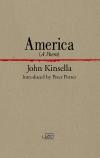
Reviewed by Abena Sutherland
1.
John Kinsella's America (A Poem) is a sixty-eight page sequence written in short, clipped lines. It is an over-long polemic or sermon becoming quite excitingly angry at the end but allowing itself to be baggy in the middle. Its strength is a turning of memorable phrase, which occurs frequently enough to maintain overall interest. "If Juvenal hadn't been so conservative. . ." If John Kinsella had found a more audacious form. . .
2.
A typical segment is this on American public-private healthcare:
Medical facilities are second to noneTwo not uncommon observations written flatly and cut into a block. If the idea of capitalism tracked in this poem seems under-determined, perhaps a slim book filled with the obvious but salutary might not be invaluable. "obvious is as obvious does." The opportunity to investigate the ways in which language is a field for power (for order) is passed over; a more complicated tracking of the operations of restless capital is evaporated into what is styled as an assembled index of the real. The proposition is: the operations of capital, the aggregates of power, can be condensed to this. There are, however, more compressed sections, intaglio on population:
so you'd rather be here for treatment
though not for the bill. Oncologically,
a dictator who's been friendly
can get good return on living cells:
there's that in common with the French.
Democracy spread:
rotogravure, internet,
corporate value
add military hoodoo,
social security moon.
3.
A stronger segment addresses a "geo-theosophy of the body", a warrior-culture,
The Nevada prophet emergedMore than any other "America" text, Kinsella's seems closest to Baudrillard, a roaming polemic alighting on particulars which become aligned within an over-arching idea, even if one segment is a long quotation, "Baudrillard says", followed by this line: "It's something to do with being French."
from a bunkered holocaust, a nihilist
with a cape, denomination – even religion –
indecipherable, though clearly
hell-bent like the general in therapy –
fine combat soldier –
who pointing out,
for point to the fun,
how much fun
it is for fun-lovers
like him and others,
to shoot someone,
a geo-theosophy of the body,
a self-fulfilling eschatology
that's the man as warrior in his house.
4.
The cover is a cardboard-colour brown with a red horizon slashed across. The brown suggests a pamphlet, readies us for the blunt propositions within. The red line could be a cut, a red ribbon to keep loose leaves together, or it could be some sort of red horizon of awareness.
5.
John Kinsella has written similar poems before, of course, though in condensed forms. An earlier text such as 'On Warhol's Camouflage Statue of Liberty & Being Refused Entry into the United States by US Immigration' shows what he can do with humour, grace and concision:
'les hons biscuits', ah, FABIS, the greatest
of gifts, the blood of/and as freedom,
Libertarian – if you look closely
she might tap dance, God forbid the can-can –
they suffered the strong fragrance but didn't
inhale the brand name: Liberty (luck):
'Have Gun/Will Shoot'; Repent AND SIN NO
MORE! And these untitled? No decay
& the ancien régime is 'trendy'
(which is a frozen & suitably bor-
ing word when not in constant use.) Solar-
isation a pissy example – in some States
you'd hold no record & Immigration
wouldn't give a shit. Paul Hogan is THERE!
6.
In the much longer penultimate segment, 'Capo dot com', Kinsella really lets off steam, seemingly goaded by cross-cutting quotations from "Capitalism Magazine: Individual Rights", copyright Ayn Rand Institute, a typical line being "They call themselves environmentalists but a more accurate term would be green bigots."
Lust property rights to steel-plate individual plightFor Kinsella, capitalism is "the maker of racism, misogyny, hatred, destruction", and the USA "collapsed star absorbing all cultures / to iron out and make good the houses on the Hudson". The eating of meat creates "slaughterhouses annulling animal souls / in slick machinery". The segment is frenetic and a pretty effective tirade siply because of its sustained anger, and that's not to be underestimated. A list or litany of the names of small-scale indigenous American societies is incorporated half-way through, a sincere gesture.
economy hicks who would kill all environmentalists,
Such a bare howl of discontent gains force simply because of its rough breaking of understatement, its direct lack of formal complexity. American foreign policy? "watch out or we'll super-size our right / to freedom". (We, they, who are these people?)
This same penultimate segment also provides America's subtitle, "or Glow", again with an idea also to be found in Baudrillard:
[. . .] it's a law
to bind as land binds and war annuls contracts
fought for compensations as a drop
in oceans so clean, so free of heavy metals,
so replete with body-stuffing and promises
of eternal life they glow, glow
in the Sargasso of our depression,
and refrain: I'd die fighting for their right
to believe that!. . . liars! You are hacking up
all outside your system [. . .]
7.
There is a constant and entertaining referencing to music – Lou Reed "appropriately bitter", Destiny's Child a "freedom-fighting non-compliant franchise", Rage Against the Machine have left "politically bereft ashes", Tom Wait's "gravel-voiced mesmerism" – especially hip-hop, Grandmaster Flash paraphrased ("don't push me, / I'm close, so close, close to the edge" – a nod to the seminal 'The Message', a track which politicised hip-hop; Kinsella's final rant is, in its plain and angry naivety, as moving as 'Beat Street'), The Last Poets name-checked, the poem's last breath containing this testament:
[. . .] O Chuck D,
Motown halycon avenging angel, as living color
speaks out: cumulatively, dialect dignity
minstrel counter-play to overturn stereotypes.
8.
As Grandmaster Flash says, "you've got to make something out of nothing at all"
[Paperback ▲ 72 pages ▲ December 2005 ▲ ISBN 1-901614-28-0 ▲ Arc Publications]
The Field of the Cloth of Gold
If you write your name with the wrong hand, the left hand if you're right handed and vice versa, then it cannot be denied that the marks are yours, the name is yours, and yet it is not your writing, not my signature at all. This is the signature which is not yours.
*
Every political scandal has a shape. The sex scandal is of particular interest. The space opened up can allow a force to interrupt the trajectory of a public figure, setting back reform, or suddenly allowing its possibility, as with George IV's "royal gambols" with his mistresses. Governance is an ordering of fields; for what is often described as "politics", the doings of parliament, a scandal can suddenly open a structuring moment of sex and betrayal, that is an area of experience which doesn't usually find a sympathy or representation in this public discourse. The result is destabilisng and unpredictable.
*
In scene one of Henry VIII or "All Is True", Norfolk describes the ceremonies at the Field of the Cloth of Gold:
Men might sayWhat does the ceremony show? Norfolk is thinking of nations, and of capital. Those who possess capital today make all former operations of capital theirs. It does not accumulate. Capital shines down the days, evaporating them. The gilded masque of two courts, two rivals for European ascendancy, provides the subject for Shakespeare (this early scene is almost certainly by him) to couple a time- and a capital-image. I run through this line in my mind, "their very labor was to them as a painting".
Till this time pomp was single, but now married
To one above itself. Each following day
Became the next day's master, till the last
Made former wonders its.
To-day the French,
All clinquant, all in gold, like heathen gods,
Shone down the English; and to-morrow, they
Made Britain India: every man that stood
Show'd like a mine. Their dwarfish pages were
As cherubims, all gilt; the madams too,
Not us'd to toil, did almost sweat to bear
The pride upon them, that their very labor
Was to them as a painting. Now this masque
Was cried incomparable; and th'ensuing night
Made it a fool and beggar.
Edmund Hardy
from Tenderly
Stephen Vincent
----------
Stephen Vincent's most recent publications are Sleeping With Sappho (Faux), and Triggers (Shearsman). The Tenderly series continues to unfold at his blog.
Tenderly #50
An iris is not the mention of butter
What melts asparagus in a spiral
The tips do not learn to flame
What did she mean when she said reave
A reaving we will go rich into
Into the mountain a forest burnt down
On one side, not on the other
Philosophical principles rest on diversion
Difference and the contrary rose one finds
In flame on the end of whose nose or was it
The hose is not a Biblical metaphor, a hose
Post-dates the Ten Commandments: Thou shall
Account, weep, take the surgical as torment
With fortune, cure. One used to love lilacs
In a poem - blue ones, white ones - that western
Nothing to deal with in the long row to the far horizon
The one with the bright, orange burnt edge. How she
Cannot get over him or the converse. What sails south
Renders a curious love, sometimes sensational,
A rounding to a rondo way beyond
Some say a signature in music
Some say the gingerbread, the curious inset
To roof, the house, architecture, stable
Beyond the, she had such a delicate
Come and touch me exquisite: no one, nor I
Can ever forget her open, tongue bursting, little mouth.
Tenderly #51
Vegetables
Carrots cure no custom here.
Brandy
What river rose lacquered a slender section
What is little, thick, a lather.
Apple
What does the rose petal purify? At the
Margin, egg white.
Tender #52
To reject conversation, to reject consolation, to
Eliminate agony. To not be either direct or formalist
To reave content, the thumbprint on the assassin's lapel
To be taken to the cleaner, to be bagged there, a pink chip
Numbered on the shoulder, a white shirt crumpled:
To disappear from the body of the not so near dead.
Tenderly #53
Swallowed into migration, swallowed by shear nastiness
Pulled by a set of invisible hands, the shadow of shears:
What puzzles melancholy, the site of a cafe called NOTHING
To be bitter and mistakenly blow your nose, shake cocaine
On the rear-end, call it a prayer. The diesel engine
In the driveway promises a darkened: it is
Not necessary to say what is darkened, Melville was darkened.
Tenderly #34
Kiss aspersion on the nose.
Tenderly #44
A corner and a width, an egg yolk burning:
What rents bears forth a white shell
An orange fog burnt at the edge. A wedge
Is not an entry. Do not look for a pearl
Inside the mustard. Pepper is what
Sweeps the heart. To be open is to be rent:
What shines in the white Iris will gather
The black ball rotates on the horizon
Swing low, sweet. Multiple and occupied:
Disappear. Reappear. Today on the cheekbone
An extraordinary sun goes: shining, burning, disparate.
----------
Stephen Vincent's most recent publications are Sleeping With Sappho (Faux), and Triggers (Shearsman). The Tenderly series continues to unfold at his blog.
Projects Pink
Edmund Hardy


Astronaut Jeff Williams of the International Space Station 13 crew noticed this ash plume emanating from the Cleveland volcano, part of the Alaskan Aleutian islands. The eruption lasted for two hours. Does NASA supply a complete Emily Dickinson in orbit? Poem 1705 runs:
Volcanoes be in SicilyHere the volcano travels from the pages of an atlas, from the striking photograph of an astronaut, and it arrives "at Home" as the poet climbs a staircase of Lava, always possible. We may feign a cheerful cry, Let the basalt fall where it may!, but there is also this vicarious toppling point located in domestic life: a tip into the molten, "A Crater I may contemplate". A volcanic violence is again taken up at the opening of poem 1748:
And South America
I judge from my Geography -
Volcanoes nearer here
A Lava step at any time
Am I inclined to Climb -
A Crater I may contemplate
Vesuvius at Home.
The reticent volcano keepsThe volcano, secretive and wakeful, is apparently teasing "precarious man" with the possibilities of "projects pink", not a term taken up by geologists, who prefer to discuss varities of pyroclastic deposit. So if a friend should indeed announce they are off to see Vesuvius or similar, whether at home or in situ, the appropriate response must be, "Buon divertimento, allora, e state attenti a non cadere nel cratere!" ("Have a good time, then, but don't fall in the crater!")
His never slumbering plan -
Confided are his projects pink
To no precarious man.
Geoffrey Hill, Without Title
Reviewed by Melissa Flores-Bórquez
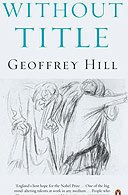
The first word of the book is an italicised Traurig, often a musical direction to play sadly. The rest of the line is: "Traurig as one is between bearers, dancers," – the sadness of a still point between movements. It could be a point of departure or death, and also dream revelation, where the bearers start dancing.
This opening poem is 'Improvisation on 'O Welt ich muss dich lassen'', this being a Lutheran chorale, a contrafacta of Heinrich Isaac's lied Innsbruck, ich muss dich lassen, a beautiful melody set twice by Brahms in his last work, the Eleven Chorale Preludes. It was also set and transposed numerous times by Bach, appearing twice in the St. Matthew's Passion (as "Ich bin's, ich sollte büssen" then later "Wer hat dich so geschlagen"). The association is always to the grief-laden leaving which is the original lyric, where Innsbruck has now become the World. Four lines later Hill's poem continues:
Queer noise going ón there like a ganderThis is a fluent conversational short-hand in which the line-breaks serve to joy along the spoken measure, the everyday patter of "stick around" and "folk throwing up" interrupted by the brisk "Dead friends are". As a speaking point of view the poem coheres around "I": an angry, mocking essayist with a wide range of reference, several registers to abruptly shift between, and a plain verse form to body forth.
rehearsing its angry call. I long to stay
immortal and ageless, to stick around
for the Bacchantes' orgy, folk throwing up.
I had a dream in which this is all real,
where we rip off our masks and sing
'O Welt ich muss dich lassen'; medics on cue
for the recite-a-thon. Forget your science.
Dead friends are no remoter than in life.
*
Though he had written after and in praise of before, in Canaan Hill began essaying the achievements of an ever broadening range of artists and orators, each one receiving a line or two, the process akin to an accountancy of styles, a list of miniature tributes. Laurel and Hardy are commended for their "flawless shambles" while Hopkins "had things so nearly right" (both The Triumph of Love) and "Shakespeare's elliptical late syntax renders clear the occlusions, calls us to account" (Speech! Speech!). And on it goes, Without Title packed with these. It's not ekphrasis, unless the form is adapted to be nested interruptions. 'Improvisations for Hart Crane' concludes "All in all / you screwed us, Hart, you and your zany epic." King Lear is reduced to three lines
Lear is too easy, the puréed madnessKarl Rahner is described in 'On the Reality of the Symbol':
a kind of parity with the mad crime,
the self-willed absence from his royal self.
(from 'Pindarics' 17)
Fine theologian with or againstBeing told that Rahner – whose range of concepts is detailed over the 23 volumes of lectures and articles collected as Theological Investigations, a range scrupulous in its unsystematic approach – was a writer whose symbolism "goes with the mystery" is akin to reading the lecture doodle of a theology undergraduate. The next line swerves away, "Parturition of psalm like pissing blood" which leads to the penis figured as an organ of translation, "the old linguaduct" – a territory of which, two pages later, Hill writes "This is late scaffold-humour, turn me off." This technique of brief summation seems better when perceiving a gorse bush,
the world, in sense that are not the world's,
his symbolism, both
a throwback and way forward, claims its own
cussedness, yet goes with the mystery.
Now here's real alchemy – the gorsethan when reading the late fragments of Pound:
on roadside terraces, bristling with static,
spectator of its own prime, inclement challenge
(from 'In the Valley of the Arrow')
[...] Pound glidedThis sounds elegantly plausible but go back to those Pound notebooks (which were bounced into publication) and "clarities of incoherence" doesn't stick. If this is marginalia the margin is a little too wide.
through his own idiocy; in old age
fell upon clarities of incoherence,
muteness's epigrams, things crying off.
(from 'Pindarics' 14)
*
Writing a reflexive poetry which ruminates darkly on the ethics of rhetorical figures has previously proved to be a skill in Hill's possession – the concentrated segments of 'De Jure Belli ac Pacis' (in Canaan)and scattered patches of the quartet of long works which followed that book. There are further examples in Without Title but overall a process of diminution seems to have occurred, "I'm spent, signori, think I would rather / crash out". The stylistic reticence which was always Hill's means of bringing a depth effect to the work is dissipated. However, the stronger poems remain compelling. One is a fine elegy, the title poem, "culling the bay bowers to which he / cannot return", which observes the process of elegising and concludes with an image of elegised life as artifice, "no restitution but with wired laurels." Another is the notably plainer in style 'Offertorium: December 2002', amid "rain-sprigged yew trees, blockish as they guard / admonitory sparse berries",
for late distortions lodged by first mistakes;The favoured Hill style of allusiveness, ellipsis and emphatic transition / interruption means that the choice of classical model for the long central section of the book, 'Pindarics', comes as no surprise; the recurring and reductive images of sexuality and the narrow permutations of a chosen form mean that "after Cesare Pavese" is well fitted. A tempered conversation of sorts with Pavese turns out to be a facilitator for close argument – subjects include lust, the body politic, fascism. When Hill's writing tries to address the greatest human pain then it tends to shift into a thwarted and urgent chorus:
for all departing, as our selves, from time;
for random justice held with things half-known
I think catastrophe; feel, touch, stasisThe sequence ends with a statement for poetry, one which the book as a whole falls short from:
wholly without stillness. The pilot scans
into the nimbus of his utmost fix;
an ancient anabasis, lift of pride.
(from 'Pindarics' 11)
Patterns of lines, mostly, raw in appearance.
I see I've defined a poem. Something I'd say
held over, deep in reserve, so that it may strike.
[£9.99, 96 pages, ISBN: 0141020253, January 26th 2006, Penguin.]
from Thelma
Robert Sheppard
Natalia
You may be certain of meeting him in Liverpool, on most afternoons between the Penny Lane junction and the bordered up Christmas Tree shop, the word 'WREATHS' peeling from its boards. Walking with his head bowed. Dodging puddles on the uneven paving. Splashed by those in the road. Towards the Oxfam shop. A daily magnet for his part-time bibliophilia. He'd even acquired an eighteenth century Milton there. But more to the point, he's hoping for the only operation that he credits chance with creating in his life (?) – that of being able to obtain once more some of the worst novels he's ever read. He gave his copies away years ago.
The attraction is the same as that of watching a one star film late night on TV. It never seems to have a title, some girl's name. The scenery trembles. The plot creaks. A plaster on the hero's left temple becomes a plaster on his right! The dialogue clogs. The actors corpse. An artifact ever more artful the more artless it becomes. Its mechanism foregrounds the artifice with each successive disaster, sabotages its emotive onslaught, film's propaganda for the agitation of fixed subjectivities. Even Thelma, watching this one, couldn't weep into her gloves, alone at a matinee showing at the London Road Odeon.
But even the re-discovery of the kitsch sensationalism of Constantine Fitzgibbon's book When the Kissing Had to Stop cannot erase the memory of the most inane (and therefore most valuable) of these productions. It is by Andrew Brighton, whom he had known on and off in Norwich. Published in the 1970s by Octopus Press of Swaffam, and set in contemporary Norwich, it traces a thinly-disguised Brighton's obsession with a woman he calls Natalia. She gives her name to the book. Though perhaps it is more accurate to say she has her name taken away by it.
Although he's not read it for years, he's certain that his memory's accurate.
It opens with an account of Natalia's role as regional muse. At a conference of thirties poets at the University, David Gascoyne, chaperoned by his wife, comments how much Natalia resembles Alice. William Empson pockets his teeth and then bows before her, Chinese style. Stephen Spender bores her to tears (literally, she sobs!) detailing the plot of a play he is writing about Hitler!
Jeff Nuttall belches at her before his poetry reading, shifts his gut with his belt, calls her a 'bit of Norfolk rough', which amuses her no end.
Malcolm Bradbury coaxes his latest literary élite to develop their obsessions, their USP, in the oak panelled snug of The Maid's Head. But their true obsession is the inspiration they detect in Natalia's wild but evasive eyes. It is impossible that Natalia does not attract a drunk to their table. Bradbury – sensing a media 'incident' – feigns invisibility. His famous bray fades. 'Brighton', the dullest of the students, tells the drunk that he has no right to breathe contaminants over the fragile unfurling of Natalia's petal-like genius. Adding, in case that doesn't work, 'Piss off!' The drunk shuffles away, muttering.
This one convincing scene in the entire 'novel' marks the beginning of the doomed relationship between the neurotic Brighton and the psychotic Natalia. They pass early evenings of quiet desperation in the Plasterers, watching endless sheets of summer rain through the open door. They meet, as though by accident, on Castle Mount, picking out the coloured awnings of market stalls below, beyond the sandy façade of St Peter Mancroft – where they once attended a concert of Cage's prepared piano music, which they disrupted by unprepared surrealist dancing. They arrange tearful rendez-vous at Cow Tower and other carious remains of the city wall, which either of them breaks at will. They push against the football crowd at Carrow as it pours over the swing bridge to taste 'the surging tide of humanity'.
This social, almost-political, remark only serves to contrast with the pervasive post-adolescent surrealism that the characters have pieced together from Athena posters, Thames and Hudson illustrateds and New Apocalypse verse. He writes: 'The lemon teardrops of Loplop drip on Lennon's lap'; words in his journal punctuated by Natalia's amateurish doodles (the sort found on any pad left long enough by a telephone): a distended tear depends from a schematic avian shape.
Finally Natalia is driven insane by the sheer parochialism of it all. It isn't Paris!
In the grip of what Brighton calls 'Octophrenic Frenzy', Natalia fragments into eight separate personalities, each tedious and intricate in equal measure, a state which stretches narrative technique. Attempts at parallel plots. Blind corners. False endings. Dissonant multiplicity. Beyond endurance and coherence.
After Natalia is removed to an asylum in Wymondham (from which, one of her personalities remarks, in its last letter to Brighton, one can see the twin-towers where the rebel Ket was hanged) she slips into eight separate comas. Brighton, who is too exquisite a personage to risk contamination by her insanity, never visits. He issues a series of self-congratulatory sub-Laingian panegyrics to the persipacity of the mad, but nevertheless authorises that her eight life-support machines be switched off.
He shoots himself one minute before opening time on the steps of the predictable Wild Man. The words he has pinned to its door only serve to betray the book's incalculable debt, its final sentence:
'BE CONVULSIVE AT WILL OR BEAUTY WILL NOT BE ALL.'
from September 12
Robert Sheppard
13: March 10
Burn friendlies on the wreck of human
terror the body of the people O!
Erato! scorched by the blaze of blue-on-blue
Eye witness. The same railway station. We.
Search out the others' errant gunshots
Enchanting for democracy O! Muse you wing it
for shepherds sporting iambic lambs on
the platform so enthralled by Love bo-
peeping his fluttery sonnet in Venus' softest target I
miss my earthly transport, and survive. No
golden glove thrusts from the dust. Erratum
for Erato: Nobody drops into the same
device twice. Human error. Petrified watch. Our
sponge of blood drips into the same device forever
14
WHO OWNS YOUR FACE? IT FLESHES
ON ALL OUTWARD EYES SIZING YOU
SONNET X PULLED OUT BETWEEN THE STOPS,
LABIALS IN THE LABYRINTH: ORPHIC RESONANCE
AROUND THE RINGING TUBE, OR FICKLE ERATO
TICKLING THE LOVESTICK POCKET
REFERENCE TO X IS A REFERENCE TO THE SUBJECT
MATTER OF THIS POEM. X, TRUE AT THE TIME
OF PUBLISHING, HAS NOT GIVEN PERMISSION. UP.
ESCAPE FROM THIS SMOULDERING FACT. TURN
AGAIN SO IT MIGHT SMILE BACK AND NOT BOIL DOWN TO
A POLLUTED POOL OF TABLOID MYTH, OR RISE AS
A PILLAR OF SMITHEREENS SUCKED BY GERMS.
X PLAYS IN YOUR EYES, SMARTING
15
Every dark is tighter, as each prescriptive
joy is held in check: precipitous release
without charge. Domestic advert for a bidet a long
mirror a civilisation. Just look at yourself
Watch what you're doing a rule with no game
in the front room you're on your back on
your own behind these friendly lines' prosthetic whine.
You empty yourself in a way to make you
you, and catch her foiling stare as you nebulate
Even now you unspeak a tongue
holed up in history's traffic, to assemble
grid-locked love bits at her tightening lips
Sex selving a sonnet for her for making
love is making love is making love is
16
A collection-source lights up the
heights of post-humanism and queue-
jumps the love-raft in survivalist fury!
Extinction, at whoever's hand, guarantees.
It can deify can worship but can never love
Total death affords the only access. Infidel
conscripts that final day will be spent
to coerce eternity. If paradise
were to persist without earth
what matter. Ab-
solute dis-incarnation redemption refutes
the one true purity is deletion a white
sheet for the lover's face don't look into
those eyes level humanity in your selves
2004
Signature & Ethics
 Robert Sheppard interviewed by Edmund Hardy
Robert Sheppard was born in 1955 and grew up on the South Coast in Southwick. His books and pamphlets of poetry and criticism are numerous; many form part of the project Twentieth Century Blues. He also co-edited with Adrian Clarke the anthology Floating Capital. Most recently he has published a collection of poems Hymns To The God In Which My Typewriter Believes (Stride) and The Poetry of Saying (Liverpool University Press). He teaches at Edge Hill University.
EH: To begin with a relationship between artifice and artifice in the writing of poetry, I'm interested in your poems apparently written from photographs, most noticeably in the Empty Diaries, though elsewhere too.
RS: Your question catches me at an interesting moment. The other day I went to Tate Liverpool to see the exhibition Making History: Art and Documentary in Britain. One of my ex-students works there as a guide. I asked her if she'd been doing any writing. She said she thought she might have had with all this art around her, but hadn't. I recommended the documentary photographs – Bill Brandt, Roger Mayne, originators of images I have used, Mass Observation – rather than the paintings in the exhibition, not because their realities are not filched and filtered, but because, if we use them judiciously and deceitfully, we can imagine that they are not artificial just long enough to achieve artifice ourselves.
For that reason, I tend not to work with whole photographs, but to look at them askance, to squint at them, as it were, to see if they are showing something they didn't mean to show, or start to narrate a history that seems to be unwilled, as in Empty Diaries. Or to see if some figural element will make me say what I didn't want to say. (Christopher Middleton: 'Poems have become experiences that did not exist before the poem.') Once used, they are discarded. As I say to students, as I take away the images they have been working from, much to their annoyance, 'It's turned into words now.' Often, I feel no need to identify the sources, because they are so unsystematically processed and unrecognisable. I'd hate readers to be able to say 'That poem describes a Humphrey Spender.' At the moment I am using notes I made from a small book of photographs gathered by the artist Hans Peter Feldmann, Voyeur, so that I am making texts at two removes from his arrangement of found images.
Curiously, I have very few poems set before the invention of photography. Fucking Time, using Rochester materials, does use visuals, but they are deeply implicated in the collaborative processes I've undertaken with Patricia Farrell. Perhaps the history of photography has dictated the temporal scope of my imagination, I don't know, but I hope not.
Patricia's books of early photos were always lying around the place; she'd be sketching from them. I've read my Roland Barthes, I haunt photo galleries, and I even take the odd photo (though only once for creative purposes, in preparing Looking North), but I am interested in a far too dilettante way. I am fascinated by the slightly out of focus quality you get in the earliest photographs, as though the world is emerging from an ectoplasmic fog, and this strange window that opens on what we assume was another world. My poem 'Shutters' was a response to the photographs of Lady Hawarden, her daughters draping the furniture in front of this foggy light beyond the open shutters. Theorising the erotics of the male gaze in this is beyond me.
I'm drawn to the richness of the materials: access to the Spanish Civil War in The Lores, or I'm playing more distant games, such as in the strand of poems through Twentieth Century Blues called 'Impositions', which (imaginatively) superimposes two images and responds to the results. (I once saw a group of paintings by Art and Language at the ICA that literally did this.) The freedom you suspect the techniques and materials grant me is that the 'thing' is non-verbal and so can be transformed into various linguistic patterns of response, either brutally close to the materials or at some considerable aesthetic distance. The nearest I get to the ekphrastic is my performance 'Sudley House' which is an (anti-)guide to one of Merseyside's most intimate, domestic art collections, but even there I mix imagery from contiguous paintings, although (since the text is performed to an audience in front of certain paintings, three Turners, a Bonington, a Corot, for example) I speak to them, almost literally. But that's a contextually determined exception, a site-specific piece.
More recently, and particularly in Hymns to the God in which my Typewriter Believes I am using verbal materials more. But your question suggests that I haven't finished with such images yet, and never will.
EH: This attraction to elements which "will make me say what I didn't want to say" seems to reoccur in your work, now more playfully than before in the "texts and commentaries" of Hymns?
RS: I took the bull by the horns, not only playfully, but wilfully, in Hymns, to immerse myself in materials that seemed alien to the Robert Sheppard whose name may not be unpeeled from the surface of my other books. The book is very European in scope; I attempt 'translations' from languages I don't know. The artists saluted are often female, or from traditions alien to my own (such as Anne Sexton), and I was working consciously against the use of images, though playing with page-space in ways I hadn't hitherto. I like the feeling of dislocation that I get when I look at the poems, the feeling that I didn't write them.
As soon as I declare a conscious proscription I am unconsciously working to unravel it (which can be a risky enterprise for a poet-critic). This morning, before approaching your question, I drafted a poem beginning with full rhyme and continuing a two-beat accentual dropped line:
Dawnlight streaks
the ice-capped peaks
Guitars sleep
on their backs and snore
Someone in the control tower is signalling me not to do that. This poem is formally similar to the 'text and commentary' on the Sephardic song you mention, although in that poem you can see how the Sheppardic variations unfold, in an almost Oulipean way, as riffs on the speculative metaphors of the 'original': 'If the sea was made of milk...' The poem was one possible THEN...
The 'text and commentary' on Schlink's novel The Reader is structurally modelled on that book (one paragraph per chapter), which is not a technique I employ throughout, but it works here; isn't that what jazz musicians call a contrafact? I'm exploring my reading response ('It made me shake!') as well as responding to the unlikely choice of material, in the very responses as I make them, building another text, with its network of associations and metaphor as I do, that takes the reader (I hope) a long way from my originary shaking. In that case it is lifting itself beyond unease, but it's also exploring the fresh unease I felt increasingly during the writing process (hence my quotations from Celan and Perec in each part as counter words, especially the latter's 'The literature of the concentration camp does not get attacked'), not least of all when I was faced with the narrator's own unconsidered attack on 'experimental writing', which implicates my practices (and Schlink's) in an ethics beyond the ethics of literacy which is the novel's subject.
Simpler answers to your question would suggest the necessity of my finding new avenues after Twentieth Century Blues, to keep going; and another has to do with age, of not feeling I have to make particular aesthetic moves because I'm following the party line. Such a formulation is contrary to the function of poetics, as I now conceive it.
EH: When you mention, "The artists saluted are often female", as a new departure in Hymns, are you particularly aware of responding more to male artists in the past?
R.S. Yes. Although at the same time significant artistic collaborators have been women. In writing Hymns it wasn't programmatic: it just happened in looking for different materials. There's also Jiri Kolar or Hugo Dachinger.
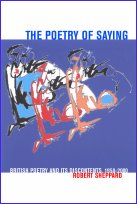 EH: I want to ask a few questions about The Poetry of Saying, your recent critical book subtitled 'British Poetry and its Discontents, 1950-2000'. Though utilising Bakhtin and to a certain extent Vološinov, you choose a different site in developing, from the concepts of Levinas, a poetics which will always come back to an ethical interpretation.
RS: I appropriated my central concepts, the opposition between the saying and the said, a sense of face-to-face encounter with otherness, substitution, responsibility, and others I have forgotten, largely after becoming very excited by the implications of Levinas's suggestive remark in an interview: 'Man can give himself in saying to the point of poetry - or he can withdraw into the non-saying of lies. Language as saying is an ethical openness to the other; as that which is said - reduced to a fixed identity or synchronized presence - it is an ontological closure of the other.' That set me off onto the development of an ethical – but I don't think metaphysical - level for my theory, to match the technical and the socio-linguistic levels. I was immensely helped by Robert Eaglestone's Ethical Criticism, Reading After Levinas (Edinburgh: Edinburgh University Press, 1997), although I think that it was also from that source that I derived the less than accurate notion that Levinas himself divorced his theological writings from his philosophy. Levinas's own response to the massacres in the Sabra and Shatila camps suggests he was not able to particularise what he finds so easy to universalise. He seems to be selective about Otherness in a way that denies the commonalities of biological humanity. What saves his philosophy (even from himself) is that it is concerned to show the grounds of ethicality in relationship, not in the diktats of moralism. It is very suggestive for the development of a poetics.
EH: In the Raworth chapter you write of Raworth's "apprehension of velocity", perhaps the speed of intuition which is the speed of practise (and performance), or going so fast that, in 'Catacoustics', "artifice swallows itself". Speed instead of "connectives". Can you say more about a social comprehension of this high speed form, in Raworth and in your own practise, your speeded-up collage where the connectives have "melted"?
RS: Velopoetics! Part of my apprehension (rather than comprehension) of speed has to do with intense experiences of listening to performances of poetry during the late 1980s. A tape of Raworth reading Eternal Sections. The experience of hearing Maggie O'Sullivan live at Sub Voicive. Both of these – the tape played over and over, the reading experienced only once – induced experiences that approach what I later equated with the openness of 'saying'. Language particles seemed to detach themselves not just from reference, but from syntax, a deterritorialised experience of language that re-territorialised as a ritornello, in Guattari's formulation, an existential refrain that sustains the self and yet melts it into forces of intersubjectivation. That's how he would put it anyway. In Raworth's case this was to do with speed of delivery (in O'Sullivan's case to do with neologism and rhythm). I don't remember whether the fact I was trying to write in similar forms made me more receptive to this, but I was also aware of making effects through a speedy delivery, of writing in ways that create fleet performances, like Duchamp's 'swift nudes' that fizz and whistle across his surfaces. A celerity of mind, part immediacy, and sustained by references to its own processes. I thought – as I do not now – that what a poem does is more important than what it says. Looking back, it seems less tied to the practice of the language poets than it appeared at the time – I'm talking about the 1980s, works like 'Daylight Robbery' and 'Swift Nudes'.
What I notice now – having checked out the CD of Raworth reading Writing - is that Raworth's work is full of interferences to the flow, jump-cuts, interruptions, that both attest to the celerity and yet break it, and this strikes me as Levinasian too, as Tim Woods and others have pointed out also. This is the necessary rupture that erupts the quality of saying into the said. The 14 line poems that Raworth 'juggled' into final assemblage seem to balance those demands absolutely.
How this translates into my own work I'm not sure. I read some of my texts at a pace, if they seem to demand it, or demanded it during their construction or creation, and I am aware of an 'accelerated collage' at work in my jumps and swings, though I am much less addicted to such procedures these days. Notational high-speed writing is perhaps an illusion (this is something I am discussing with Cliff Yates at the moment, for his PhD), an artifice that initiates liberation in the reader; Pound intuited that 'images' produced just this sort of ritornello, so it's nothing new. Of course I am not validating speed alone (the logic of Velopolis we live within); mental celerity must equate with more foundational notions of the aesthetic and the imagination, or even ethical action, rather than pure technical proficiency. I am intensely aesthetic rather than technical.
EH: In your chapter on Maggie O'Sullivan you write about the "spectral saying on the saidness of the material page" which is reading, and quote Christopher Middleton on the voices of a text which, launched by the poet's, are "a kind of endophone." So reading involves an inner speaking and an inner ear, voices imaginary and unmistakable. You seem to have a level of faith in reading as the other of a text? "To read is to be proximate to, to face alterity as distance, and be implored to answer, as Bakhtin would say."
RS: That last remark is a description of this interview, isn't it, but maybe of all textual dialogue?
Despite what I say about the effectiveness of O'Sullivan reading above, or perhaps because of it, really... You are quoting from a caveat right at the end of the book about the limits of performance, which is pretty much an unquestioned valorised term in the poetics I've been associated with – and, of course, I've done my bit as a performer and I'm proud of it! Middleton – a marvellous writer of poetics as a speculative discourse and a poet of major significance, it seems to me; I am currently re-reading him – argues that the sonic patternings of language are too complex to be perceived in oral performance alone. His conjectures suggest an important limitation upon performance, or rather, they displace actual performance onto a more complex performative relationship with the eye and brain, which is just as bodily in its way: 'The reader imaginatively somatizes the vocality of the text, for it has aroused in him various other sense-traces, which may be hard to fix'. It's a slightly different point, but my reading of O'Sullivan's poem 'Naming' in The Poetry of Saying is a slow motion tracking of semantics and etymology, sonics and page-spatiality, through the text. It necessarily interrupts performance in a narrow sense.
There's a broader point here, I think, which links my long-held faith in the reader with more recent questions of form. I noticed, at the Partly Writing conversations I attended at Bury in 2005, some contributors really wanted to get text moving, quite literally, morphing and diving on screen, which is, of course, a form of performance. (In fact, florid-faced lecturers are already bouncing textual fragments across their multi-coloured Powerpoint screens in quite an alarming way.) What they seemed to be forgetting was that the movement of the reading eye across the printed page already performs that kind of spatial dancing, a little like Middleton's sonic eye. If you're not careful, the performative in the hands of some performers – not Raworth and O'Sullivan, of course – does our reading for us. People are shouting at me! That text is morphing before my eyes, beyond my control or recall! These are experienced as alienating, endless streams of saying, not at all like the experience of reading and re-reading Raworth, but as something un-anchored to the said, the necessary materiality I talk about in my book, that stops the saying and the said becoming merely a tired binary. (Certain concrete poems get very pedantic in their iconicity, though never the great ones, which are concerned with the nature of signification itself.) Only a kind of restedness can allow us to appreciate the irreducible otherness of the work, from which it derives its power, it seems to me. To borrow a formulation of Derek Attridge, literary works must be allowed to stage their own meaning(s), which is what Raworth and O'Sullivan can do.
EH: You mention that you've written a few short stories recently. What's going on there?
RS: For ten years I've taught creative writing and worked with fiction writers as well as poets at Edge Hill. In a very ordinary sense, the skills of editing I have learned about fiction made me decide simply: it's time to have a go, and stage my own meanings! Actually, this is a return to work I was doing years ago, and there's always been a touch of fictionality and narrativity in my poetry anyway. But the forms that are coming out are quite interesting to me. They are works of poetics – that other discourse to which I willingly owe allegiance: a 'text and commentary' on Breton's Nadja set in Liverpool, called Thelma, or stories about writers which chew over issues at the heart of writing. (The first part of Thelma will appear in Tears in the Fence soon.) Having written a book on Iain Sinclair probably has something to do with it too. The fiction obsesses over the ethics of writing, sometimes parodying my actual poetic work to test its limits. But it's too early to see where this will lead, or even how much I will attempt to publish. Oddly, the stories rise unbidden into consciousness, like false memories, and demand to be written, quite unlike the poetry. I think the experience is quite a profound one because it seems to be changing the way I'm working, the ways I think about my poetry, in a fashion that is not conclusive enough to express yet.
This has also got something to do with the experience of reading Christopher Middleton again (though that is my current pre-occupation): his sense of the poem as artefact mediating the world of things and language, his feeling for the liminal and the demonic, his conjecture that poetry comes out of 'a sudden swerve of language crystallizing in some daring, voiced image, which somehow alerts the whole nervous system', as he puts it in his Shearsman book Palavers. They are both provocations to my habitual ways of thinking and working, I suppose. And that, at the greatest level of generality, is what poetics does to you, for you, if you are receptive as a writer.
I have a sense of wanting to move towards a writing that is both complex and lucid, that avoids my most obvious 'avant-garde' strategies. I also feel that I no longer belong to a grouping of writers, a fructifying feeling I certainly had in the decade from 1985 in London (which I even allow myself to trace in The Poetry of Saying - and can be found on my Pages blogzine as the serialised 'A History of the Other'). At a certain age I suppose poetics becomes more individualized. In fact, I just found myself saying all of these things in a footnote to an article on Krszyztof Ziarek recently, quite unbidden.
EH: Can you say something about your new 'September 12' poem?
RS: One of the impulses behind writing fiction was to swerve away from this sequence of near-sonnets because I felt that it was the best thing I'd ever written. Its poetics are probably embodied in a piece entitled 'Rattling the Bones (for Adrian Clarke)' which appears on Softblow and which will hopefully stand at the head of a volume. It's pretty clear what happened before September 12, of course. It's about the aftermath of that – which sounds like an inadequate summary. I'm currently working on another sequence of 24 to supplement it, at the moment called 'September 10', the ones that I mentioned earlier, that use my notes from Feldmann, and the little quote from the opening lines of a poem comes from that too. I hope you will forgive me if I decline to say much more about it - the fear of talking it away, or of falsely influencing it, and all that. Instead, here's the one I wrote yesterday, still in draft form, the ninth of the series. It can also stand as an unpolished example of my use of multiple photographic images:
Giving Up Whatever Ghost
He slouches in the front row of the stalls
adjusting opera glasses at his nose. While he
inspects the safety curtain you scrutinise his nape,
scrubbed, beneath his slicked-back denial of hair
The curtain rises; his glasses descend. Democracy
breaks out, caught in its own crossfire:
Teargas hits the centre of the crowd; it fans out
cursing and gasping. One hand reaches
for the bread; three mouths moisten in this:
The soprano's dress slips down her frame.
The ringlets of her wiry wig cascade
as crescendo beckons; her throat tightens.
Her shoulders struggle free into the perfect air
of purest song; embrace wordless blackout.
E.H. Is Guattari's Chaosmosis an important book for you? When you speak about Guattari you seem to get closest to a politics of writing.
RS: Do I? I use a small part of Chaosmosis in The Poetry of Saying – one of the bits I could understand, I am no exegete of this material - as part of an argument about autopoiesis in the work of Maggie O'Sullivan – her becoming embodied in her poems - that is actually lifted by Guattari from early Bakhtin. There was a time when everybody read Deleuze and Guattari but now they only read Deleuze. (At this moment Patricia is working downstairs on her PhD on Deleuze (and Lyotard).) Guattari's relegated in that reassessment despite the contribution he made to Deleuze's thought, to the development of concepts (which, they both agreed, was the purpose of philosophy).
I was much taken by a 1987 micro-text of Guattari published in Poetics Journal 8 called 'Text for the Russians', which was an address to writers in which he talks about making 'virulent fragments of partial enunciation work by virtue of shifts in subjectivity', making ritornelli, and also states: 'The poetic function is more than ever called upon to recompose artificially rarefied and resingularized universes of subjectivity' and he praises poetry's 'capacity to promote active, procedural ruptures at the core of significatory tissues and semiotic denotatives, from which to set new worlds of reference to work.' (It's what we all want to hear and my 'Empty Diary 1987' pays homage to, and quotes from, this brief and suggestive statement.) I might then have been more interested in those linguistic 'tissues' than the 'worlds of reference' – but it gave me a different way in than the language poets, maybe, to begin thinking about Twentieth Century Blues. Some of this returns in Guattari's Chaosmosis which – Patricia tells me – is regarded by the continental philosophy community as incoherent.
Over the last year or so I've been reading Guattari's historically prescient late essay of 1992, The Three Ecologies, which argues for the inter-dependence of the psyche, the socius and the environment. Thelma launches off on this one: 'Just for once a book, opened at random, has an answer. It says I am "a montage of drives haunting the socius"'.
Following on from the ethical turn in my thinking – The Poetry of Saying and also my poetics piece The Anti-Orpheus (free e-book) I find myself approaching an aesthetic turn – there's a real turn here (at last) in the culture, represented by a book like Derek Attridge's The Singularity of Literature. All of which takes me back somewhat – it's not a homecoming but a new discovery – to Adorno and Marcuse, and thus back to the political as embodied in the estrangements of form. (The latter is the 'unnamed thinker' in the fourth of my Berlin Bursts on Shadow Train.
Most recently I have been considering Krzysztof Ziarek's The Force of Art (2004), which tries to make an anti-aesthetics of out of both Adorno and Heidegger.
Ziarek conceives of the work of art as a force field. It is not an object but an event, inhering in neither form nor content, and this eventness makes the artwork a forcework, in his central neologism.
In the work of art, forces are no longer tethered by the dominant social reality. In a redefinition of the concept of the autonomy of the artwork, as that is theorised by Adorno, Ziarek insists not only that artworks transform and re-work their forces, but that they transform the ordinary relations of social power, and the receivers of the artwork can carry this non-violent, power-free relationality into social praxis. All this sounds very promising, politically speaking. However, Ziarek's dissolving of the artwork as an object in order to maintain its forcework, means that artistic making (and poetics as formulations of that), artistic materiality and medium (and aesthetics that account for the negotiation of these) are ruled out of court, so that formal innovation as a factor in contemporary artistic and literary practice is undervalued. In short, it's a book that doesn't (yet) speak to me as a poet, so it will have to await its moment. I'm not very scholarly or philosophical about all this – and ever more aware of this as Patricia's work progresses - but I hope that I don't produce what Marjorie Perloff witheringly calls 'theory buzz'.
EH: In the Anti-Orpheus the letter there ("Signature Style") speaks of the act of signature. What are the implications of that act?
RS: You sign the frame because you are responsible for the artefact you produce and you should say so afterwards. Robert (or whatever your author-function is) made this. It is not to say that the 'me' that makes the text is the 'I' that might (or might not) appear in it. Neither is this 'signature' in the metaphorical sense of a significant stylistically identifiable set of traits or procedures that seems to unify an author's work – and Perloff has written recently of signature as such an 'identifying mark' in the work of the language poets, a group of writers who have been vociferous against the effects of 'voice' in poetry, which is, of course, the most common metaphor for this.
But there is another rôle for 'authoredness', as Derek Attridge calls it in The Singularity of Literature. 'A full response to the otherness of the literary work includes an awareness of, a respect for, and in a certain sense ... a taking of responsibility for, the creativity of its author.' We acknowledge the poem, or whatever, has been 'written' he says, is 'a writing' which requires a reading, in the fullest sense.
While Perloff is not advocating a simple return to 'voice', neither is Attridge advocating a simple return to author's intentionality. Both an ethics of signature and an awareness of authoredness belong to the reading of a work. This doesn't mean this won't have implications for (or in) the act of creativity, if only this is holding such formulations in your mind as you write. Perhaps this is partly what Roy Fisher was enacting, making his mark, when he wrote, in Wonders of Obligation,
The things we make up out of language
turn into common property.
To feel responsible
I put my poor footprint back in.
E.H.: In your interview with Tim Allen for the Salt book Don't Start Me Talking you mention, in passing, a poetics of strands (almost to be found) in Yeats as he returns to particular places and themes. In your Twentieth Century Blues the strands are named and numbered. How does this idea of strands relate to the cubo-seriality identified by Charles Bernstein or other ideas of stretched (if broken) composition?
RS: The idea of strands was very distantly suggested by Yeats – those Coole Park poems – and also by Robert Duncan's 'The Structure of Rime' sequence that cuts across his books, between poems, and then I wondered what would happen if you permitted yourself to link not just one sequence but several and then allow them to interrelate and interrupt one another. Very early into the project I described the method as I saw it developing (in the article 'Poetic Sequencing and the New'). Certainly I was thinking about Zukofsky, filtered through Barrett Watten's writing on him, quoted in that piece, and about Allen Fisher's multiple-reading routes through Place (rendered slightly redundant by the recent book presentation of that work). I probably had more anti-models than models, more examples of what I didn't want it to be. It's actually a set of hyperlinks, although that example was unknown to most of us when I began in 1989.
In this question about my work I find it is impossible for me to present a reading or contextualization of it, because I believe deeply that that is the freedom of the reader and critic. I can talk about poetics, of course. But I can never read my own work: in fact, I passionately believe that that is the reason for the existence of poetics as a specific discourse, to allow writers to have dialogue with their processes without imposing interpretations upon their products.
E.H.: What was the atmosphere like at Writers Forum over the time that you attended? Can you remember the first time you went?
RS: No, I can't remember the first time, but it was only in the 1990s, although I had known Bob since 1973: the first poet I'd met, by the way. The atmosphere was described in my piece for Bob's 75th birthday, rather well, I think: the mixture of rapture, drunkenness, exuberance and concentration. It had the structure of a Quaker meeting; anybody who got the call could stand up and give forth. Anything goes was the aesthetic rule but there were subtle controls, Bob's eyes mainly. He had these deep-set penetrating eyes that could look through you. And so: you would get the regulars like Lawrence Upton, Adrian Clarke, Betty Radin, Johan DeWitt, Patrick Fetherston and Patricia and myself, always with something new to offer, and a number of them (not me) performed sound poetry with Bob. Jennifer Cobbing (Pike) would drop in to dance now and then, all in the upstairs room of a pub with a pool table in the centre, covered with Writers Forum booklets. Then he'd have extraordinary guests: major concrete poets like Lora-Totino or Pierre Garnier, the Russian sound poet Dimitri Prigov. Steve MacCaffery and Karen McCormack dropped by to see us all once. I'm in danger of leaving names out... I wish I'd kept better records….
In short it was the least directed and most focussed workshop I've ever attended, whose atmosphere I greatly miss, but sadly believe I would never be able to approximate, as a workshop facilitator, either inside or outside the academy. It was also a venue for visiting writers, as I've said, and it was the slipway for launching every Writers Forum booklet. It was also a place of friendship, and occasionally a bit of fighting.
E.H. Might we see a follow-up to The Poetry of Saying, another large critical project?
RS: The Poetry of Saying took 25 years to finally get done. My little book on Sinclair took a couple. So I'm getting quicker! I have plans to write a book on the discourse of poetics within formally innovative poetries, but apart from a general piece defining poetics – and a couple of articles – one on Allen Fisher and Charles Bernstein, another on Maggie O'Sullivan – nothing has been written yet, other than a proposal. But the more I think of what I 'should' do as a critic makes me feel slightly desperate to get back to writing poetry.
[Interview edited from an email exchange between Edmund Hardy and Robert Sheppard which began on 17th April 2006 and continued for four weeks.]