Three etchings from Keats
Foliage
and on
Her voice I hung
like fruit
among
green leaves
All foam and roar
all foam and roar
Streams subterranean
those spouting columns
fretwork, streaming round
Alive, and dazzling cool, and with a sound
Haply tumults
interlace
delicatest lattices
in a wink to watery gauze
curtained canopies
liquid broideries
Of flowers, peacocks, swans, and naiads fair.
Swifter than lightning these wonders rare;
then the water
mimicked
frieze
A Suggestion
like a demon mole
Work through the clayey soil
To see skull,
coffined bones
each form marred
with human soul
----------------------------
EH
[#] Other Etchings

Follies: Monk & Goya
Melissa Flores-Bórquez

We are gathered here todayThese are lines from Geraldine Monk's 1980 Writers Forum pamphlet, La Quinta del Sordo, which is (roughly) The House of the Deaf Man, famously the name of Goya's two-story rectangular (according to art-historical research) cottage outside Madrid. Goya bought this in 1819, painting the "black murals" in oil on the walls. During the first five of the nine years he spent in the house, his last nine years, Goya also created Disparates ("Follies"), a series of etchings, the final grotesques from the sleep of reason.
because peacocks are pretty birds
and perfect monsters of iridescence
Did they begin withThe wax and acid of etching: the words in their formations, centred, prose with blank gaps, residual lines, the metal plain of the manual image of which paper can receive the print, printing as that moment in which paper is "awoken from its nightmare of whiteness" (Bachelard, The Right to Dream). Monk's hand often steadies itself against existing material - Goya, Hopkins, the dirge Lyke Wake, Donne - and runs resist and acid to deepen cuts, force new marks. Of La Quinta del Sordo Nate Dorward writes: "Flesh has become liquid or wax, so that distinctions between one, two or many figures are effaced."
a sharp and a parched rasp
a hissling furnace
a gang of heckling menace
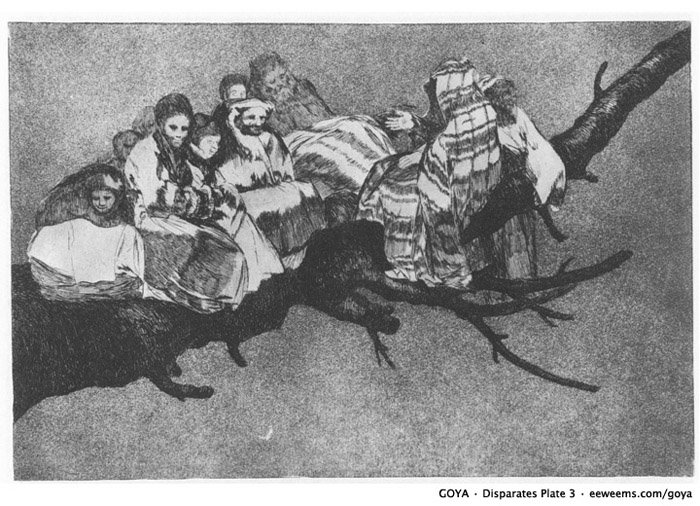
The etching which depicts a group of people clustered on a black bough provokes Monk's "We are gathered here today...", perhaps the sermon given by the shawled figure addressing the others, the words which wash through the gloom,
we are too smug and swingingHow can a twinned voice, which is double, attached to itself, speak out? Goya's siamese figure, "You will go where I go where I and you go. . ." Goya imagines this conjoining (from the picture, it looks like Ischio-omphalopagus, a Y shaped spine) as a burden, with the dominant twin taunting a crowd. Monk writes,
happy from this bough and bony thing
Let us reckon hard
with this block vengeance
Monk's wash of voices over these etchings reveals a technique of spoken dream, an oneiric space in which the image of the social has become unbounded, bodies without border: to write, to etch, to create surfaces by outlining them; to make marks upon the strongest material. To superpose perspective on perspective. Come, before the terrible sack race is lost.

Etchings
Edmund Spenser
Griefe: A Short Conversation
O but (quoth she)
great griefe will not be tould,
And can more easily be thought, then said.
Right so ;
(quoth he)
but he, that neuer would,
Could neuer : will to might giues greatest aid.
But griefe
(quoth she)
does greater grow displaid,
If then it find not helpe, and breedes despaire.
Despaire breedes not
(quoth he) where faith is staid.
No faith so fast
(quoth she) but flesh does paire.
Flesh may empaire
(quoth he)
but reason can
repaire.
Edward Thomas
Digging
To-day I think
Only with scents, – scents dead leaves yield,
And bracken, and wild carrot's seed,
And the square mustard field ;
Odours that rise
the root of a tree
Rose, currant, raspberry, or goutweed,
Rhubarb or celery ;
The smoke's smell, too,
a bonfire burns
The dead, the waste,
And all
to crumble
over
mirth.
Robert Herrick
Blossoms
Faire pledges of a fruitfull Tree
They glide
--------------------------
Edmund Hardy
William King's How To Eat (1698)
Argument
I'll teach what's choice, what plentiful, what waste,
And lead you thro' the various Maze of Taste.
The Edible Art
Unless some Sweetness at the Bottom lye,
Who cares for all the crinkling of the Pye?
*
The child who nightly to the larder skulks
Will grow a Belly of unwieldy Bulk.
*
Eat Beef or Pye-crust if you'd serious be.
A Shell-fish'll raise Venus from the Sea.
*
Some Sauces act as Friends, and others Foes:
The Roguish Mustard, dang'rous to the Nose.
*
May clouds of Pigeons round about thee fly
But condescend sometimes to make a Pye.
*
Where Love of Wealth and rusty Coin prevail,
What hopes of sugar'd Cakes or butter'd Ale?
*
In private draw your Poultry, clean your Tripe,
And from your Eels their slimy Substance wipe.
*
Many a Man who falls out with his Wife
With soft'ning Mead and Cheese-Cake ends the Strife.
*
May Beef with carrots and with brown Ale join
And may you knight, with knife, the bold Sir Loin.
*
If you like tasty snacks then have you try'd
A Turkey Poult, from Egg, in Batter fry'd?
*
Your guests possess big Stomachs, bigger Souls –
Prepare you Muttons swol'd, and Oxen whole.
*
Before you chop, to Paris you must go,
That you might taste French Soups, and Mushrooms know.
*
Crowd not your Table, let your Number be
Not more than sev'n, and never less than three.
*
In days of old, the food a soldier got:
Fowl, Bacon, Cabbage, Mutton, and what not.
*
A gentle Lamb has rhet'rick to plead:
She sees the knife, she intreats, and she bleeds.
*
The humorsome child will make great clutter
Till she has Windows on her Bread and Butter.
*
On Empire's gilt all Delicates are seen,
And what was Earth before becomes a rich Terrene.
*
Only the Mad lard Pork with Orange Peel –
Like garnishing Lamb with a Spitchcockt Eel!
*
If the huzzah-ing Mob on you prevail
Swell them with fat Beef soup and Stoop of Ale.
*
When sallading go out, fresh leaves to seek:
The poynant Water-grass or sav'ry Leek.
*
If Horace came as Cook, he'd soon rehearse
A labour'd Work, and every Dish a Verse.
*
Dessert is crown: let Creams incircl'd be
With swelling Fruit just ravish'd from the Tree.
------------
EH
S.D.G.
"it will be naturally supposed that his poems were rather the amusements of idleness than the efforts of study" - Samuel Johnson
[#] William King's Art of Cookery (Google Books)
[#] Other etchings